Man of Sorrows by Niccolò di Tommaso
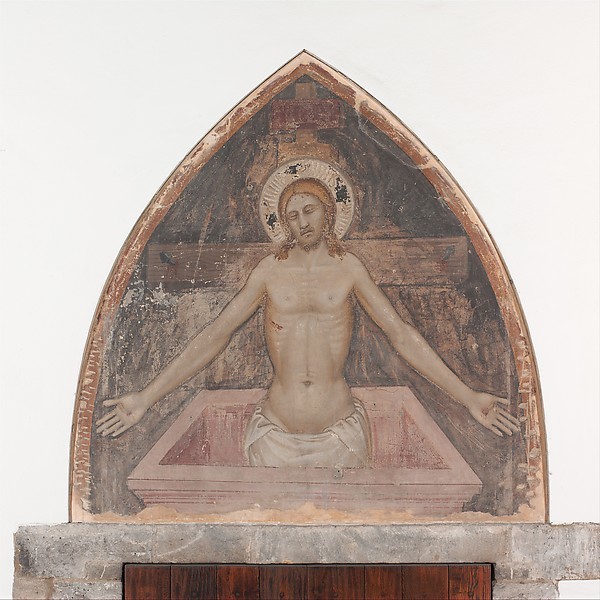
In this final Italian Man of Sorrows image, we see a more simplistic Man of Sorrows image that is faithful to the original Byzantine iconography. It is a former fresco by Niccolò di Tommaso that was later transferred to canvas [1]. Painted approximately in 1370, the fresco likely hails from a monastery in Florence. There, it may have been located in a portal or archway given its curved shape. If the fresco was in a place where people would walk underneath it, then the image of Christ would have risen above them like Christ rising from the tomb. Hence, while the iconography represents the Passion, viewers’ engagement with it would have produced the transfiguration of Christ.
In the image, Christ is depicted upright with the Cross behind him. His three upper-body wounds are shown, his head is slightly inclined toward his right side, and his eyes are once again closed. Christ is unclothed down to his waist, just below which the tomb hides his lower body. The tomb is somewhat strangely shaped. The attempt at perspective seems to be poorly executed, making the tomb appear like a square well. Moreover, it looks like the Cross behind Christ is inside the tomb as well. Finally, Christ’s arms are quite widespread. We have previously seen a Man of Sorrows (folio 167v of the Karahissar gospels) that was more deathlike than normal. The outstretched arms here have the opposite effect; Christ is somehow strong enough to move his hands significantly away from his body despite his deathly state [2].
We end with this image as a reminder of the first Byzantine Man of Sorrows depictions before moving to the central and northern European images, which are often strikingly different from what we have seen so far.
1. “Man of Sorrows,” The Metropolitan Museum of Art, accessed December 9, 2016, http://www.metmuseum.org/art/collection/search/472301.
2. Hans Belting, The Image and Its Public in the Middle Ages, trans. Mark Bartusis and Raymond Meyer (New Rochelle: Aristide D. Caratzas, 1990), 74.