Man of Sorrows and David Playing the Harp
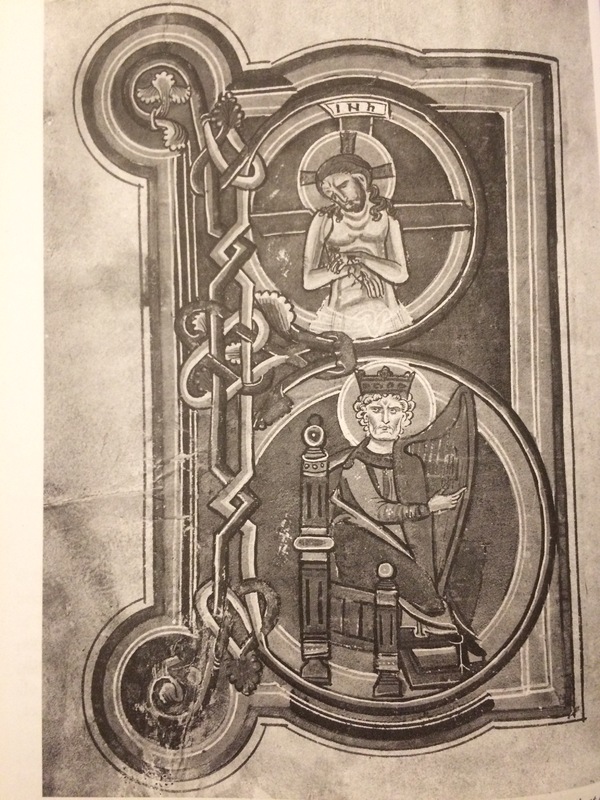
For the last image in this exhibit, we look at an illuminated initial B in a German psalter [1]. This psalter is believed to have been created in approximately 1265 in Magdeburg. What makes this particular Man of Sorrows so interesting is that Christ is juxtaposed with the figure of King David playing the harp, a combination that we have not yet examined. Inside the top circle of the B is the Man of Sorrows in what initially appears to be a very traditional style. Christ, shown down to his waist, stands before the Cross with his head inclined toward his right side. The two wounds on Christ’s hands and the wound in his side are depicted, and his hands are crossed just below his chest. However, his eyes are not closed but only half-closed, as if the artist decided to extend Christ’s half-dead, half-alive state to his eyes [2].
In the lower half of the letter, David is portrayed seated while playing a harp. He has a crown on his head and appears to look into the distance. This far-off look may be exactly what the artist intended if we consider one possible reason why David is present alongside the Man of Sorrows. Jurkowlaniec notes that David may be considered a prefiguration of Christ: David “died and was buried in a grave where his body decomposed, in contrast with that of the Son of God who did not remain in the Abyss and whose body was unaffected by decay” [3]. Thus, David’s eyes may look off into the future of Christ and the New Testament.
Hopefully, this brief exhibit has given the reader some sense of the astonishing spread of the Man of Sorrows, a complex and at times strange iconography. Along the way from Byzantium to the far reaches of Europe, time and place altered the image and lent it new forms. Yet, through all this it remained a unique iconography that represents the Passion but does not tell the story of it.
1. Grażyna Jurkowlaniec, “The Rise and Development of the Man of Sorrows in Central and Northern Europe,” in New Perspectives on the Man of Sorrows, ed. Catherine Puglisi and William Barcham (Kalamazoo: Medieval Institute Publications, 2013), 54.
2. Jurkowlaniec, “Rise and Development of the Man of Sorrows,” 60.
3. Grażyna Jurkowlaniec, “A typological confrontation of the Man of Sorrows and David at the turn of the thirteenth century,” Konsthistorisk tidskrift/Journal of Art History 73 (2004), 92.