Dominican Plaque
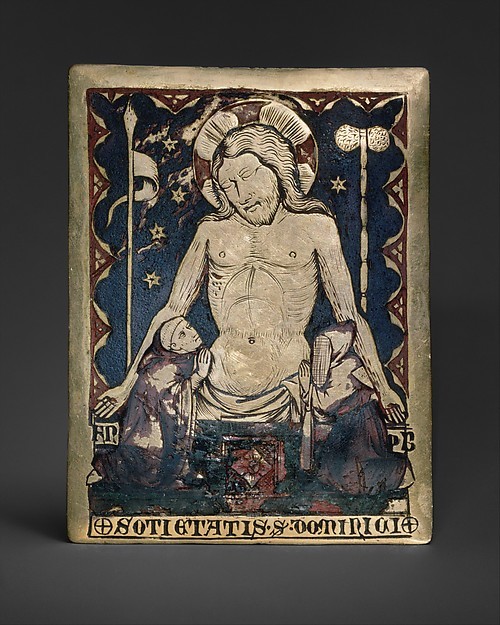
We next look at a late fourteenth century plaque that puts an interesting spin on the Man of Sorrows iconography [1]. The plaque, made of enamel and copper, features a half-length figure of Christ against a dark blue background. The standard slightly tilted head of Christ with closed eyes is depicted. Three wounds, namely the two wounds in the hands and the wound in Christ’s side, are shown. His arms are held slightly away from his body. Additionally, two instruments of the Arma Christi are present: the sponge on the right and the lance on the left. The tomb that Christ stands in here is well-integrated into the image, again reflecting the more mature stage of the Man of Sorrows iconography by this time.
Two aspects of this painting make it quite different from the other Man of Sorrows images that we have seen. First, there is no Cross in the plaque. This further distances the iconography from having any true narrative quality, for now there is not even the presence of the Cross behind Christ to give his upright stance any semblance of support. The second unusual feature is the prominent addition of two figures in the foreground of the image [2, 3]. The figure on the left is a monk and the figure on the right is a flagellant with his back exposed. This is a clear anachronism, as the Metropolitan Museum of Art notes, but one that is quite easily explained [4]. The Latin text at the bottom of the plaque indicates that this object likely belonged to a Dominican friar. Thus, the object would have been used for personal devotion. Supporting this hypothesis is the small size of the plaque, less than half the size of the folded Umbrian diptych, allowing it to be easily carried by its owner. Therefore, as the plaque’s owner prayed with the object before him, the friar in the plaque would mirror his actions.
1. “The Man of Sorrows,” The Metropolitan Museum of Art, accessed December 9, 2016, http://www.metmuseum.org/art/collection/search/466100.
2. “The Man of Sorrows.”
3. “The Man of Sorrows | Heilbrunn Timeline of Art History,” The Metropolitan Museum of Art, accessed December 9, 2016, http://www.metmuseum.org/toah/works-of-art/1982.480/.
4. “The Man of Sorrows | Heilbrunn Timeline of Art History.”