Double-Sided Icon with the Virgin Hodegetria and the Man of Sorrows
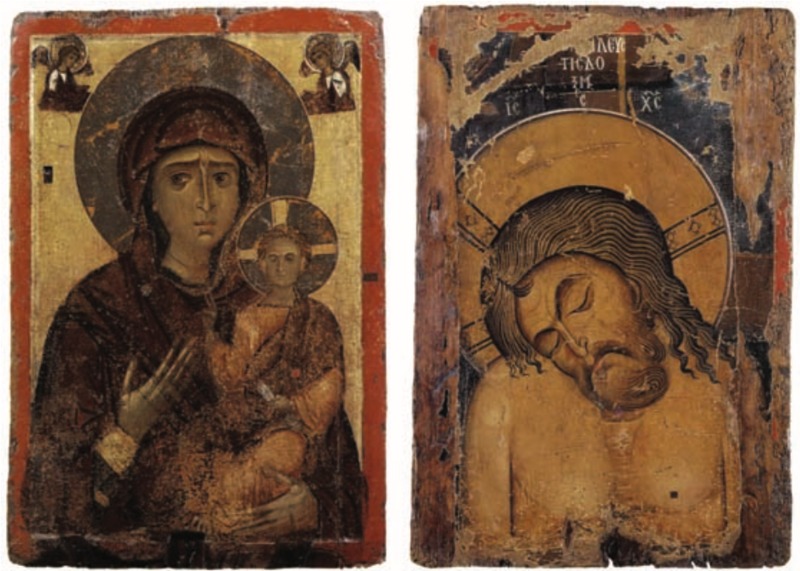
We begin our journey through the Middle Ages with the oldest extant panel painting containing the image of the Man of Sorrows [1]. The panel, dating from twelfth-century Kastoria in modern-day Greece, is actually painted on both sides. One side depicts Christ as the Man of Sorrows and the other shows the Virgin Hodegetria. The latter is a style in which the infant Christ sits in the Virgin Mary’s left hand while the Virgin points her right hand toward him [2]. We consider both sides of the panel here (and not just the Man of Sorrows side) because they are, in a quite unusual manner, related. First, in this early use of the Man of Sorrows iconography we see the image’s defining features. The Cross is stationed behind the crucified and unclothed Christ who is standing upright. However, Christ is not nailed to the Cross, being rather in a “state of living death” [3]. We can clearly see this because his arms are at his side rather than stretched out along the Cross [4]. This scene does not correspond to a particular event in the Bible but serves instead to figuratively represent the whole of the Passion. In this object, Christ’s eyes are closed; as we will see, Christ’s eyes are opened in many later Man of Sorrows images.
On the side of the panel containing the Virgin Hodegetria, we observe something unusual. She is holding the infant Jesus, an occasion for joy, but instead there is an expression of deep grief on her face. Thus, the Virgin Mary is aware of and reacting to the Man of Sorrows image on the other side of the panel [5]. Why would the artist choose to employ this strange relation between the two sides of the panel? Hans Belting suggests that this is a pictorial version of Byzantine ritual songs used in the Passion liturgy [6]. Some of these songs contain Mary grieving over the Crucifixion while simultaneously recalling Christ’s youth, exactly what the Virgin seems to be doing in this panel painting.
The use of this object and its viewership may be deduced from the damage on the bottom of the panel. A pole was used there to raise the panel and carry it in processions [7]. This indicates that the panel was viewed by a large number of people, familiarizing them with its iconography and acting as an object of devotion. This devotional purpose is painted into the image of Christ; the artist zooms in on Christ’s upper body to mimic deep “contemplation as an act performed by the viewer” [8].
1. Helen C. Evans and William D. Wixom, The Glory of Byzantium (New York: The Metropolitan Museum of Art, 1997), 125.
2. Evans and Wixom, Glory of Byzantium, 125.
3. Colin Eisler, “The Golden Christ of Cortona and the Man of Sorrows in Italy: Part Two,” The Art Bulletin 51 (1969), 233.
4. Grażyna Jurkowlaniec, “The Rise and Development of the Man of Sorrows in Central and Northern Europe,” in New Perspectives on the Man of Sorrows, ed. Catherine Puglisi and William Barcham (Kalamazoo: Medieval Institute Publications, 2013), 50-51.
5. Hans Belting, The Image and Its Public in the Middle Ages, trans. Mark Bartusis and Raymond Meyer (New Rochelle: Aristide D. Caratzas, 1990), 94.
6. Belting, The Image and Its Public, 94.
7. Evans and Wixom, Glory of Byzantium, 126.
8. Belting, The Image and Its Public, 105.