Man of Sorrows in MS I F 401, fol. 75r
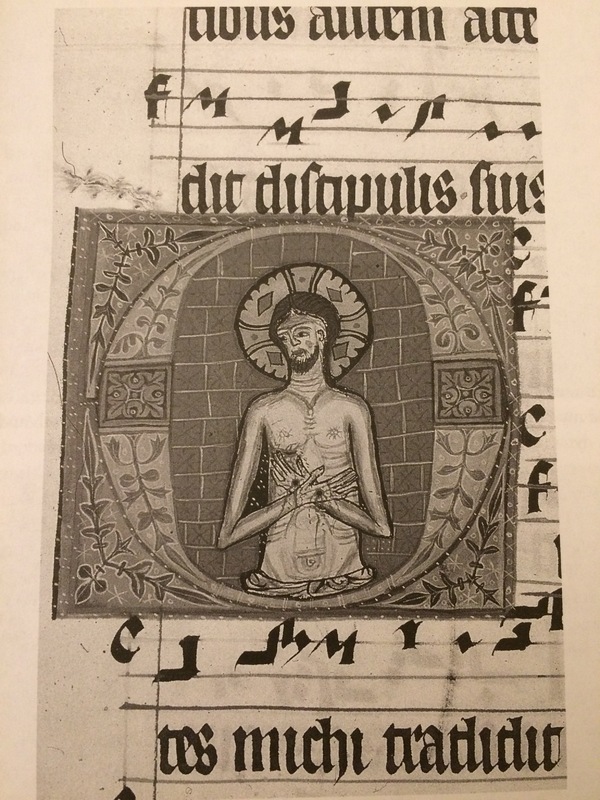
This Man of Sorrows image comes from an early 1300s Silesian Antiphonary, which contains liturgical songs [1]. An illuminated initial O contains a half-length portrait of Christ. We immediately note the absence of the Cross behind Christ’s figure. This absence becomes much more interesting, however, when we consider that the rest of the Man of Sorrows image depicts Christ in a relatively lifelike state. His eyes are fully open and his head is not particularly tilted, lending Christ the appearance of control over his body [2]. Moreover, the blood from Christ’s three upper-body wounds is very prominently displayed here. This makes the wounds seem fresh, as if Christ was just removed from the Cross. In fact, all of these features seem to indicate that the scene being depicted is immediately after the Crucifixion, which makes one wonder why the Cross is not portrayed. The resolution to this mystery, as we have seen, is that there is no single “scene being depicted.” The Man of Sorrows iconography, in the Byzantine Empire and in fourteenth century central Europe, is meant to be symbolic of the entirety of the Passion.
As this was a book of liturgical songs, it seems possible that the figure of Christ in the small initial O was only glanced over rather than deeply pondered. If so, then this represents a radical departure from the initial purpose of the Man of Sorrows iconography as a devotional image designed for contemplation of the suffering of Christ. Perhaps the Man of Sorrows image had become so widespread that it was no longer a carefully selected depiction of Christ but instead a common portrayal.
1. Grażyna Jurkowlaniec, “The Rise and Development of the Man of Sorrows in Central and Northern Europe,” in New Perspectives on the Man of Sorrows, ed. Catherine Puglisi and William Barcham (Kalamazoo: Medieval Institute Publications, 2013), 60.
2. Jurkowlaniec, “Rise and Development of the Man of Sorrows,” 60.