The Man of Sorrows in the Four Gospels of Karahissar, MS Gr. 105, fols. 65v and 167v
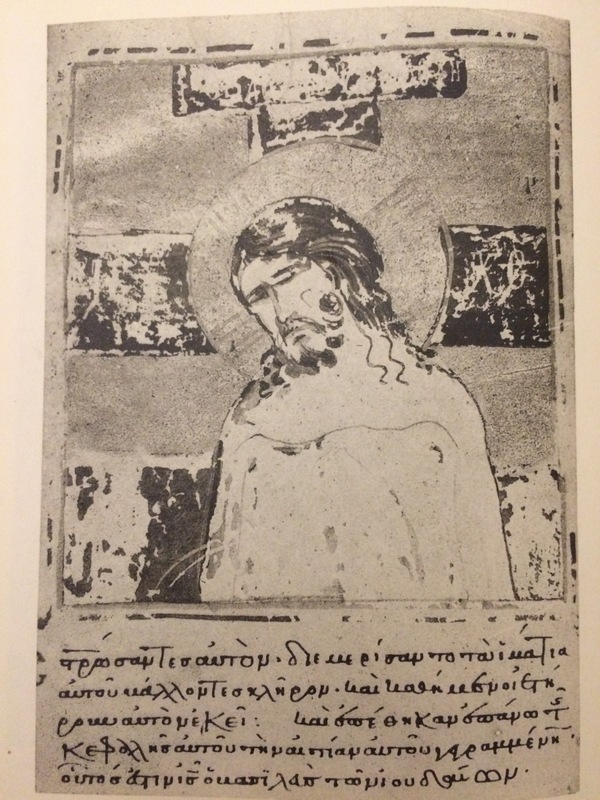
These two miniatures come from the Four Gospels of Karahissar, a Byzantine manuscript from the 1180s [1]. Both are early representations of Christ as the Man of Sorrows, although they differ from each other in an interesting way. Folio 65v contains an image that seems roughly similar to the Kastoria Man of Sorrows. Christ is again depicted without clothes and with the Cross behind him [2]. His eyes are closed, and while Christ is no longer on the Cross, he is still upright and suffering. Unlike the Kastoria panel, we do see one of the wounds of Christ on his right side with blood jetting out of it. The presence of the wound contributes to the emerging concept of the Man of Sorrows as a devotional image, as it triggers feelings of pain and sorrow in the viewer. Overall, this miniature appears well-proportioned with the Cross framing Christ’s head in the center, belying the youth of the Man of Sorrows iconography.
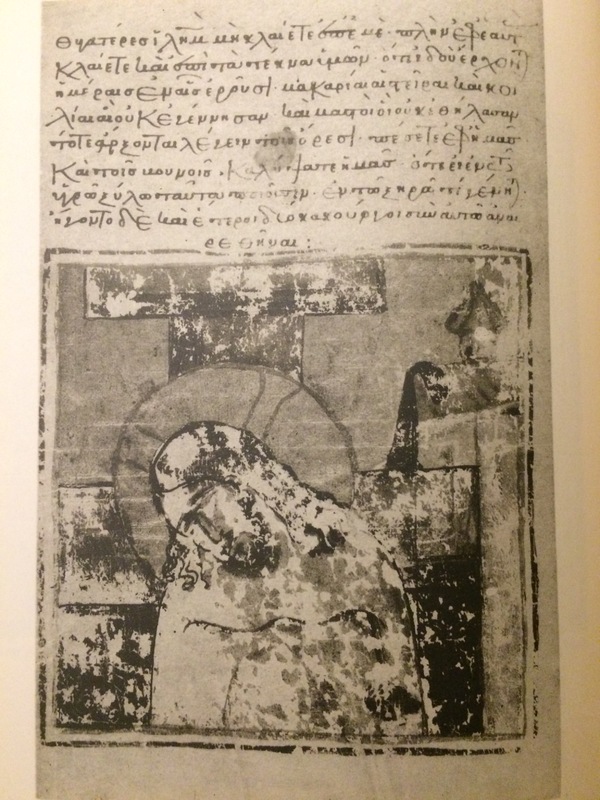
On the other hand, the miniature on folio 167v reminds us that these are some of the earliest Man of Sorrows depictions. In comparison to the image on folio 65v, Christ’s head is tilted closer to his right shoulder and his body is an almost green color, suggesting that Christ is “more completely dead” [3]. Harold Willoughby further comments that the inclination of the head and the framing of the head with the Cross are not well executed in terms of balance and proportions [4]. Another sign of the iconography’s novelty is the cramped “addition of the tomb as a domed structure” on the right side of the image, which does not seem to fit in cleanly with the rest of the miniature [5].
As parts of a manuscript, these images certainly had a much smaller audience than the Kastoria panel. Viewers of the manuscript would have likely been socially and financially well-off. Perhaps they recognized these Man of Sorrows depictions as unusual, but almost certainly viewers realized that the images represent the Passion and felt the grief that the images convey.
1. Hans Belting, “An Image and Its Function in the Liturgy: The Man of Sorrows in Byzantium,” Dumbarton Oaks Papers 34/35 (1980/1981), 7.
2. Harold R. Willoughby, The Cycle of Text Illustrations, vol. 2, The Four Gospels of Karahissar (Chicago: The University of Chicago Press, 1936), 176.
3. Willoughby, Cycle of Text Illustrations, 349-350.
4. Willoughby, Cycle of Text Illustrations, 350.
5. Hans Belting, The Image and Its Public in the Middle Ages, trans. Mark Bartusis and Raymond Meyer (New Rochelle: Aristide D. Caratzas, 1990), 108.