Folio 203v from the De Grey Hours
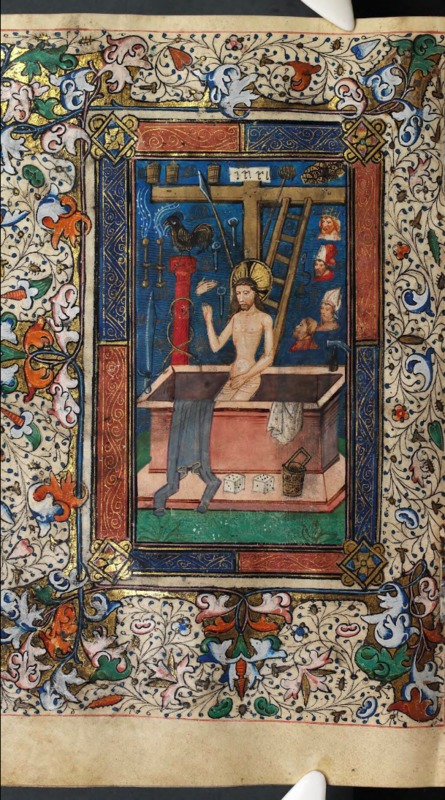
In this miniature from a medieval Book of Hours, there is a clear departure from the previous Man of Sorrows images we have examined. The manuscript, known as the De Grey Hours, was produced in Flanders around the year 1390 for British buyers [1]. The pages are made from vellum, and there is lavish decoration throughout the manuscript. Such Books of Hours “became popular symbols of wealth and prestige,” indicating that this manuscript’s viewers may have been more concerned with the richness of the decoration than with the iconography itself [2].
Nevertheless, the iconography of folio 203v is fascinating. Christ is not standing in but rather sitting down on his tomb. This allows approximately three-quarters of his body to be shown. Christ’s eyes are open, as is more common in central and northern Man of Sorrows depictions [3]. Unlike all of the previous images we have seen, Christ’s head is not tilted, and his right hand is raised as if to give a blessing. Perhaps this is meant as a blessing of the owner of the Book of Hours. Like in Oderisi’s Man of Sorrows, Christ wears the crown of thorns. Along with the presence of this symbol of suffering is the diminished emphasis of Christ’s wounds, the blood from which is only faintly visible. Finally, the Arma Christi and several figures from the Passion are portrayed, helping the viewer to sympathize with Christ’s suffering.
These alterations of the original iconography are far from surprising. From the Byzantine Empire to Flanders over the course of several centuries, it is in fact amazing that such a unique depiction of Christ is still being used. The basic elements of the Man of Sorrows are still present, from the Cross to the half-alive, half-dead body of Christ, and this alone demonstrates the influence and perseverance of this iconography in the Western medieval world.
1. “The ‘De Grey’ Hours,” The National Library of Wales, accessed December 9, 2016, https://www.llgc.org.uk/en/discover/digital-gallery/manuscripts/the-middle-ages/the-de-grey-hours/.
2. “The ‘De Grey’ Hours.”
3. Gertrud Schiller, The Passion of Jesus Christ, vol. 2, Iconography of Christian Art, trans. Janet Seligman (London: Lund Humphries, 1971), 198.