The Coin, Politics, and Religion
In Honor of the Royal and the Holy
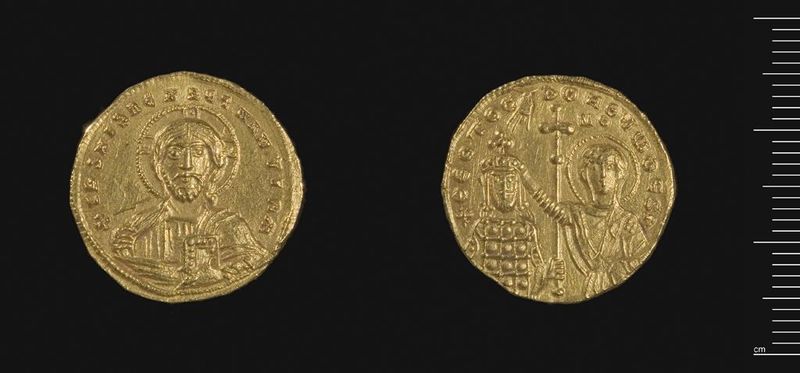
Aside from being a mode of transaction, coins in the Middle ages also served political and religious purposes. It was standard for the ruler to issue coins with a glorified depiction of themself as well as a religious icon. In the Byzantine world, some of this practice was derived from Roman predecessors. Roman coins featured a profile bust of the emperor that was stylized to highlight his firmness, glory, and power. (1) The Byzantines altered this tradition slightly, switching from a profile view of the emperor to a forward facing view. This has to do with the highly religious nature of Byzantine imperial culture and of the empire in general. A Byzantine ruler was semi-divine and directed through God's will, and he had to be drawn accordingly. In Byzantine iconography, it was customary to depict holy figures in a frontal pose as to achieve a direct relationship with the onlooker. (2) It is possible that this is the reason for the shift in posing of the imperial figure. Coins also would feature a clear depiction of a holy figure, often Jesus or the Mother of God, to parallel the image of the emperor.
The histamenon shown features Christ on the obverse and on the reverse, John I with the Virgin touching his crown in a gesture of blessing. The use of religious imagery highlights the significance of divine rule in the Byzantine empire.
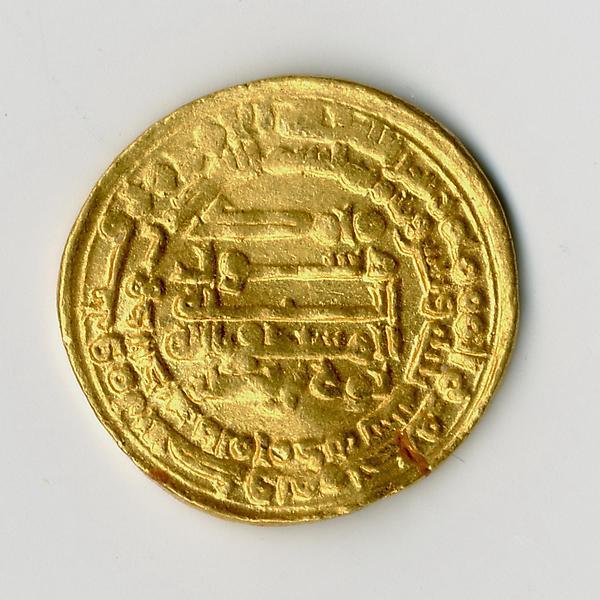
Similarly, coins in the Medieval East were charaterized by glorification of the ruler and the divine through text. Though coins in the Islamic world relied much less on images, they still fulfilled the purpose of making a political and religious statement. The 10th century Islamic coin shown here was minted in the city of al-Muhammadiya, just as the Samanids had taken hold of the city. The central region of the coin names the Samanid ruler, Nuḥ bin Nasr and Muhammad, and the perimeter contains verses from the Qur'an. The close relationship between rulership and religion that is demonstrated here is a theme that recurs throughout the Middle Ages, and the coins testify to this.
Debasement
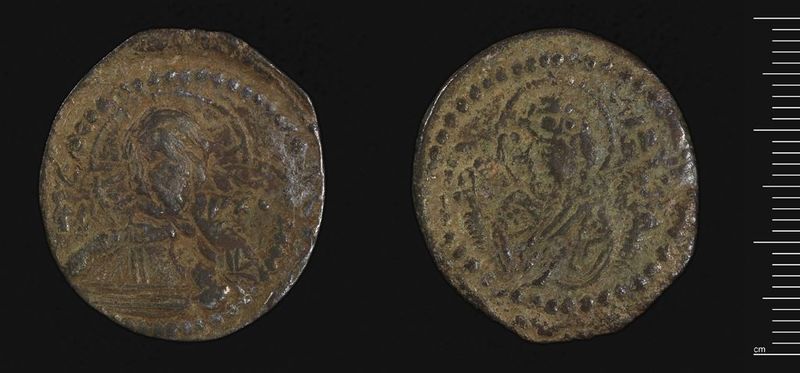
The tetarteron emerged in the 10th century and flourished through the 11th, and it provides valuable insight into the economic status of Byzantium during this time. The tetarteron was originally produced to closely resemble a histamenon. It is said that early versions were visually indistinguishable from the histamenon. The difference existed in their gold content: while a traditional histamenon contained 22 to 24 carat fine gold, the tetarteron started with around 21-22 carats. (3) Despite this, the tetarteron was circulated at the same monetary value as the histamenon. This tactic reveals the corruption of the Byzantine state during the late 10th and early 11th centuries. It is commonly speculated that the state payed its expenses in the lighter tetarteron while taxes continued to be payed in the histamenon, ultimately increasing the state revenue. The supposed reason for the necessity of such a practice was detailed by Nikephoros Bryennios during the reign of Nikephoros Botaneiates (r. 1078-81) as follows:
"He did not grant the highest honors to the most notable... but to all those who asked for them. [...] as a consequence, expenditure exceeded revenue by several times. [...] For the influx of money which derived from Asia and which went to supply the treasury ceased because the whole of Asia fell into the possession of the Turks, and since that deriving from Europe also decreased drastically, because of its ill-use by earlier emperors, the imperial treasury found itself in the greates want of money." (4)
This particular bronze tetarteron exhibits additional features that point to instability in the Byzantine empire. First, it doesn't seem to have been made by a single set of dies. Rather, one side seems to use a die from Constantine X and the other from Romanos IV. Additionally, the coin has been overstruck, meaning that new designs were imprinted in an existing coin as opposed to a blank. From this we can gather that the empire may have been lacking in materials, unable to afford to produce new coins and dies, or hastily producing lighter coins in the cheapest way possible.
1) "The Development of the Byzantine Solidus" Lawrence University, Accessed Dec. 5, 2016. http://www2.lawrence.edu/dept/art/BUERGER/ESSAYS/BYZANT3.HTML.
2) Cavarnos, Constantine. Guide to Byzantine Iconography. Boston:Holy Transfiguration Monastery, 1993.
3)Allen,Larry. Encyclopedia of Money. "Byzantine Debasement." Santa Barbara: ABC-CLIO, 1999.
4)Laiou, Angeliki E. The Byzantine Economy. Cambridge, UK ; New York : Cambridge University Press, 2007.