Creative Reuse
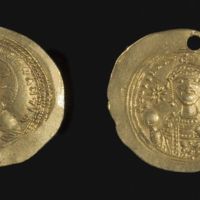
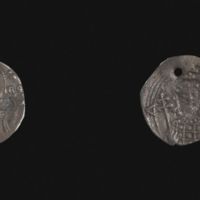
The Coin as a Devotional Item
A common afterlife for a Medieval coin is the religious amulet. Since coins almost always featured an icon of Jesus Christ or the Virgin Mary, they had a popular reuse as a charm or necklace. They could be easily pierced and strung to be carried as a personal devotion/protection item. This use did not depend on the denomination of the coin or the value of the material, for we find holed coins of various types throughout the Middle Ages. The Coin of Constantine IX is a gold histamenon from c. 1055 and the Coin of Romanos IV is a smaller silver coin from c. 1070. A common feature that these (and other) amuletic coins share is the placement of the hole. In both, the hole is placed above the head of the ruler and consequently below the holy figure. It is thought that this is so that when worn around the neck, the wearer can lift the amulet to their face and see the icon upright. It is interesting to consider that the depiction of the ruler, which was initially so important to the identity of the coin, mattered so little once it ceased to act solely as currency.