Religious Invocations in Altarpieces

Perhaps the clearest examples of religious invocations in the Middle Ages can be found in medieval altarpieces. Since they occupied a central position in churches, the altarpieces needed to encourage religious devotion and promote a pious atmosphere. This could be done, for example, by depicting religious stories or figures. Yet, while the invocations are generally quite easy to pick out and obvious in purpose, the manner in which the holy is invoked is not necessarily so simple. One intriguing example of this subtlety can be found in Roberto Oderisi’s The Man of Sorrows. This Italian panel painting, created approximately in 1354, formed the altarpiece of the Neapolitan church of Santa Maria Incoronata. It depicts Christ in the style of the Man of Sorrows, in which his attributes combine life and death (e.g. he is standing, but his arms are crossed in a burial position). Surrounding him are the Arma Christi, the instruments used during the Passion. Finally, several other Biblical figures are present in the painting including Mary and St. John. Thus, the religious references in the altarpiece are both clear and abundant. What is more interesting is why this particular invocation (namely, the Man of Sorrows image) may have been chosen. One line of approach in attempting to answer this question is to examine the image’s effect on its viewers. In looking at the painting, it is difficult not to feel grief; Mary and St. John are heartbroken, Christ is wounded, and all three figures stand in Christ’s tomb. While this is not a scene from the Bible, it is extremely effective at emotionally moving the viewer to feel Christ’s suffering, a major goal of medieval devotional art. In addition, the Arma Christi are an interesting choice of imagery. Why would the Passion be displayed symbolically? One can hypothesize that the Arma Christi were employed here to purposefully overwhelm the panel’s audience. In one glance, the viewer sees the entire Passion displayed before him. It is a powerful reminder of all that Christ endured and of why the viewer should renew his commitment to piety and devotion.
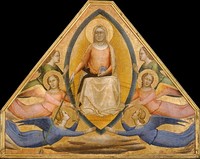
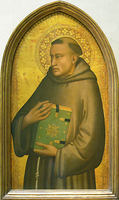
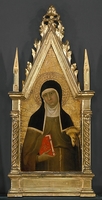
These additional examples of medieval altarpieces illustrate the variety of religious subjects that could be depicted. For instance, St. Anthony and St. Clare died only about one century before being painted into these altarpieces. On the other hand, more established Biblical moments, such as the events surrounding the Assumption of the Virgin, remained common themes.