Censer with Scenes from the Life of Christ
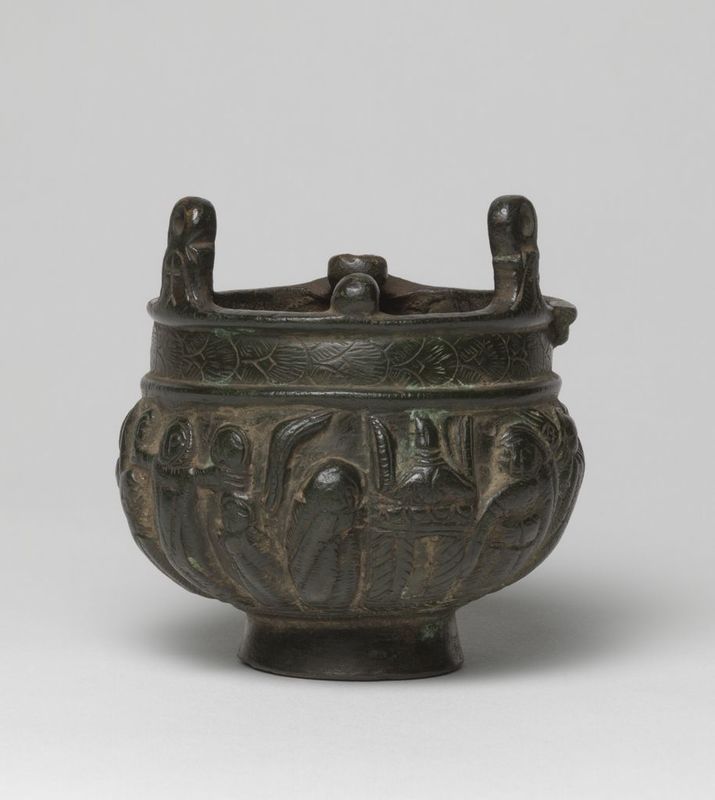
This copper alloy censer from the Harvard Art Museum most likely hails from the Holy Land but is difficult to date precisely (6th-9th century). It depicts five scenes from the life of Christ: the Annunciation, the Nativity, the Baptism, the Crucifixion, and the Women at the Tomb. This censer was created via the lost-wax process, made as a cast of an original. It appears to have been hung or held by a chain, given its three suspension rings. Censers such as this were utilized during household worship as a means of calling upon spirits to intercede on their behalf. The smoke from the censer was believed to carry a person's prayers upwards to heaven. Additionally, censers like this were thought to provide protection and to possess healing power. The scenes on this censer also serve to invoke religion by offering physical representations of the life of Christ to the beholder. These scenes map both places of scripture and places of pilgrimage, allowing the object to be used during veneration and suggesting that this censer may have emerged from the Holy Land as a token of pilgrimage. With this idea in hand, the censer might have also served to spread the Christian religion and promote worship, given its images and prescribed use. This can be viewed as an extension of the religious invocation described above, as it would promote further invocation as more and more people funneled to Christianity.
This copper alloy censer from The Boston Museum of Fine Art most probably hails from Syria and dates to around the 7th century. It depicts the same five scenes from the life of Christ as the censer above: the Annunciation, Nativity, Baptism, Crucifixion, and Women at the Tomb. In addition, this censer was used to invoke the intercession of God/saints during prayer and was seen as a symbol of protection for the household.
This copper alloy censer from The Walters Art Museum again traces its origin to Syria and dates between the 7th and 8th century. Unlike the previous censers, it depicts the Virgin and Child Enthroned instead of the Baptism. This censer would have been used/regarded in the same way as the above censers, in terms of religious invocation, but was cast from a different model, presumably of the same class of Christ censers.
This copper alloy censer from The British Museum hails from the Middle East, similar to the above censers, but is modeled differently and dates to the 8th-10th century, slightly later than the other censers. As it is damaged, only three scenes are visible: the Presentation at the Temple, the Crucifixion, and the Women at the Tomb. In addition, this censer is shaped more like a jug than a bowl, unlike the previous censers, offering a contrast within this class of censers.
http://www.mfa.org/collections/object/censer-55014
http://art.thewalters.org/detail/27283/censer-with-scenes-from-the-life-of-christ/
http://www.britishmuseum.org/research/collection_online/collection_object_details.aspx?objectId=58655&partId=1