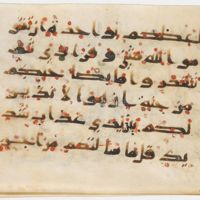
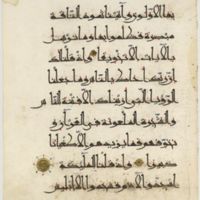
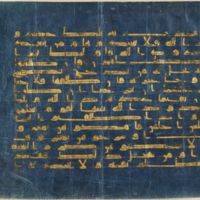
Page from a Quran
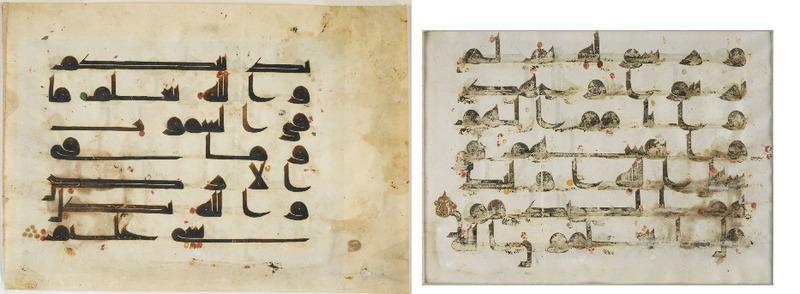
This folio from a 9th Century Quran is the only Islamic artifact in this gallery, and the only artifact without an image of a person. This is no mistake. In the Islamic faith, pictorial representations of the divine are forbidden. The strikingly bold and beautiful script in this Quran serves to glorify God instead. The particular style presented here, known as the Kufic style, is known for its elongated, simple characters.
The wide margins and large characters on this particular folio indicate a disregard for efficiency; whoever ordered the production of this manuscript cared little about the price of parchment. This folio, in fact, is almost certainly part of a multi-volume set. Thirty volume sets became especially popular during the 9th Century, and they were designed specifically for use during the thirty-day period of Ramadan. One can then imagine how this Quran would have been used. A relatively wealthy individual would have purchased it from a shop, found a place for it in his home, and used said Quran to help him recite his daily prayers.
Pay attention to the word “help.” Our hypothetical owner would have used this Quran primarily as a memory aid. Observe the upper-left-most word of this folio – “nikum.” Translating directly what is on the page gives us “nkm,” i.e. nikum with the vowels missing. The absence of vowels was common in early Quranic manuscripts. This reflects the fact that those who owned these Qurans didn’t read them so much as they utilized them for mnemonic ques; “nkm” is enough to bring to one’s mind the word “nikum,” so long as one is already expecting “nikum.”
The Quran, like much of Arabic literature, possessed a rich history of oral transmission - indeed, the word “Quran” is Arabic for “recitation.” This folio is therefore a remnant of a living, breathing religious tradition.