Seals with Secular Iconography
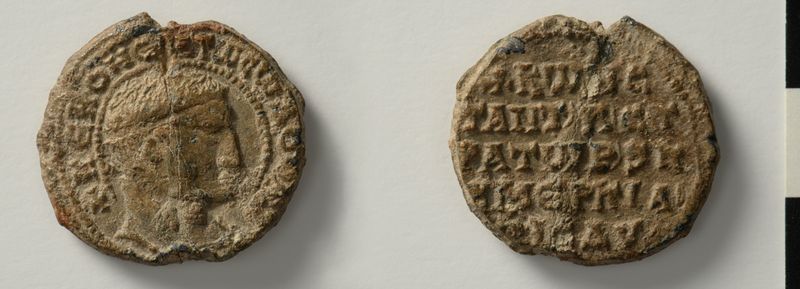
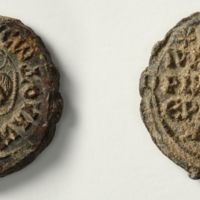
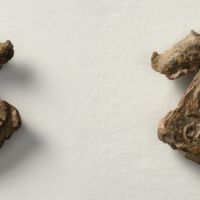
The choice of the inscription on the seal would have been something personal to the individual who made the seal. One of the mains misconceptions of the Byzantine era is the notion of Byzantium as purely Christian and exclusively religious, Although Byzantine society was driven by religion and usually employed religious iconography, (particularly in reference to Christianity) secular aspects of the Byzantine World were just as important and expressed. In the case of Constantine, Kommerkiarios of West, the choice the depiction of an athlete reflects the presence of an institution of athleticism in the Byzantine Empire, an aspect this individual might have enjoyed or found interesting. (1)
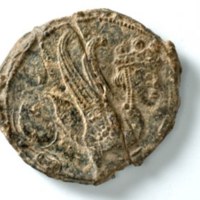
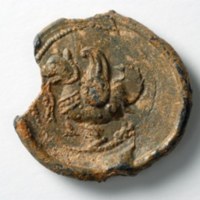
Mythical creatures, beasts and pagan deities were just as prevalent in Byzantine culture as well. In a period dominated by religious influence, secular expression rooted in ancient Greek and Roman culture was common as well in the Byzantine Era. Take for instance the griffin. A few examples of seals of kommerkiarios are shown depicting griffins and winged lions. The griffin was a sacred animal to the Greek god Apollo, and was deemed in ancient times as the guardian of treasure and watcher of kings. It was depicted in stories as vigilant and loyal, a swift and yet monstrous and divine creature. Winged lions embodied similar characteristics, as both a powerful yet agile creature and can be founded rooted in Persian and Sumerian mythology. Winged lions also represented the religious aspect of Byzantine culture too: the creature was associated to St. Mark, one of the Apostles of the Bible. (2) The decision of a kommerkiarios to put this on one’s seal can be speculated as a desire of the contents being sent to be done so quickly as well as the seal on the contents being sent embody the protection only a great beast could provide. (3)
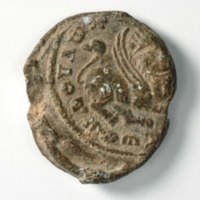
Another example of a more secular image on a seal can be seen on the seal below of George imperial spatharios and kommerkiarios of Chalida (his choice being a peacock). Although the peacock would in time become a Christian symbol for the the resurrection of Christ, its initial significance could be found in ancient Greek, as a patron animal to the Greek goddess Hera, and as a symbol of immortality. 2) This might explain why Christianity chose to adopt this symbol into its own institution. As one can see even in the institution of kommerkiarios found in mercantilism of the Byzantine Empire, a very prevalent yet less acknowledged aspect of the Byzantine World can be found.
(1)"Introduction: Byzantine Seals and Sigliography." Dumbarton Oaks Research Library and Collection. Dumbarton Oaks, n.d. Web. 23 Oct. 2016.
(2) Maguire, Eunice Dauterman., and Henry Maguire. Other Icons: Art and Power in Byzantine Secular Culture. Princeton, NJ: Princeton UP, 2007. Print.
(3) McGeer, Eric, John W. Nesbitt, and Nicolas Oikonomides. Catalogue of Byzantine Seals at Dumbarton Oaks and in the Fogg Museum of Art. Washington, D.C.: Dumbarton Oaks Research Library and Collection, 2005. Print.