Seals with Religious Iconography
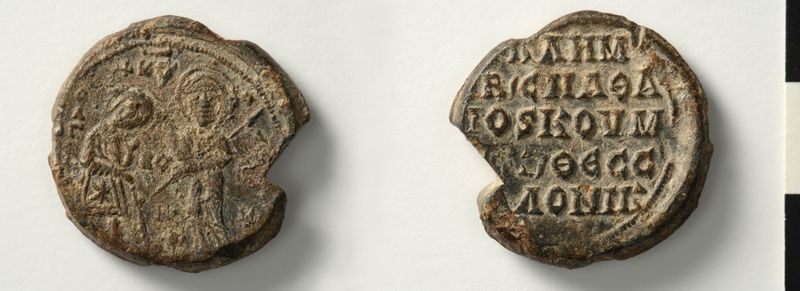
As one might infer from the previous section, religious iconography played a vast role in the Byzantine World. More often than not, images pertaining to the Christian faith were present on the seals belonging to different individuals during the Byzantine Period. As shown, the seal of Klement, imperial spatharios and kommerkiarios of Thessaloncia contained depictions of saints of the Church as it pertained to his preference and profession. The spatharios was a military title, and thus the choice of a patron saint of battle and military, St. Demetrios, would be something very appropriate for an individual like Klement to place on his seal. In addition to St. Demetrios, St. Nestor another saint of battle and individual associated with St. Demetrios is present on the seal. This decision reflects a larger institution at place in the Byzantine World at this time: focus on holy individuals specific to one’s way of life was common throughout the Byzantine Empire. (2)
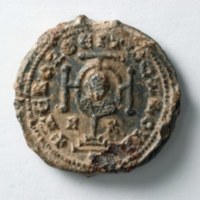
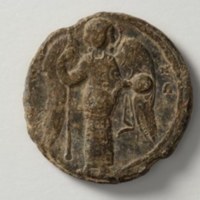
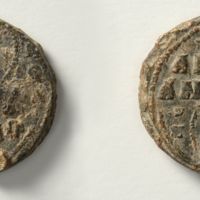
The seal of Agallianos, kommerkiarios of Abydos, contained a depiction of Saint Nicholas with his hands performing a blessing. Abydos was one of first instances of where kommerkiarios arose, and the seals used in this area reflect a bigger picture of a place immersed in Christen culture. (3) Christianity was a very present factor of the individuals who lived during the Byzantine Empire (and throughout many nations during the Middle Ages) and objects used in their daily lives would have reflected this. Thus it is not surprising to individuals such as these would have chosen religious imagery important to them, especially saints specific to their occupation. Images of Angels and ornate crosses were present not only on seals, but coins, art and many objects in the Byzantine Empire. The choices of image found on such simple imperial objects found in mercantile aspect of the Byzantine World truly do reveal much of the life of the Byzantine people (2)
(1) "Clement Imperial Spatharios and Kommerkiarios of Thessalonica (tenth Century)." Dumbarton Oaks Research Library and Collection. Dumbarton Oaks, n.d. Web. 09 Dec. 2016.
(2) Krueger, Derek. Byzantine Christianity. Minneapolis: Fortress, 2006. Print.
(3) "Agallianos Kommerkiarios of Abydos (eleventh Century)." Dumbarton Oaks Research Library and Collection. Dumbarton Oaks, n.d. Web. 09 Dec. 2016.