Coins: Fusions of Religious and Secular
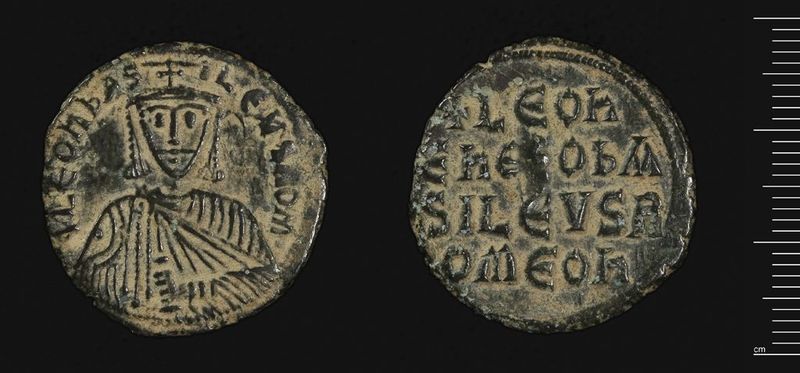
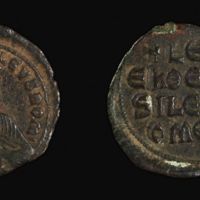
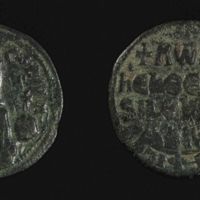
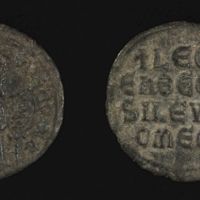
A kommerkiarios would have surely had to deal with coins as a tax collector, and these coins would have contained rather interesting details of the iconography of the individuals who ruled the empire of the time. Coins of the Byzantine Empire had an interesting way of incorporating both religious as well as secular iconography, and was prevalent from the start of the Byzantine Empire to its ultimate demise. Given here a are a series of Follis coins depicting the emperors during the tenth century emperors of the Byzantine Era, particularly Leo VI and Romanos I. Most of Leo Vi’s follis refer to him as “Leo the Wise” and a prayer similar to the one’s written on the seals of kommerkiarios, (“Lord, help your servant…”) can be seen. An image of a divine king with a crown and beard can be seen on follis alike for emperors of Byzantium.
The Byzantine Empire regarded itself as a continuation of the Roman Empire, and the only true difference separating the two was the incorporation of Christianity as the religion of the land. Thus the choice of imagery presented on the coin is rather interesting. In the case of most of these coins, the emperors are indeed imprinted on the follis, however, they are presented in a very Christ-like way. A labarum can be found on most of these coins, and this christogram, a symbol of the crucifixion of Christ, served as the background of a coin that emphasized the emperor. Thus the continuation of the divine aspect of the king (secular), now infused with Christ-like qualities (religious), is present in coinage of the Byzantine period.
(1)Grierson, Philip. Byzantine Coinage. Washington: Dumbarton Oaks Center for Byzantine Studies, 1982. Print.
(2)"Leo VI (886–912)." Dumbarton Oaks Research Library and Collection. Dumbarton Oaks, n.d. Web. 09 Dec. 2016.
(3)"Romanos I (920–944)." Dumbarton Oaks Research Library and Collection. Dumbarton Oaks, n.d. Web. 09 Dec. 2016.