Manuscripts
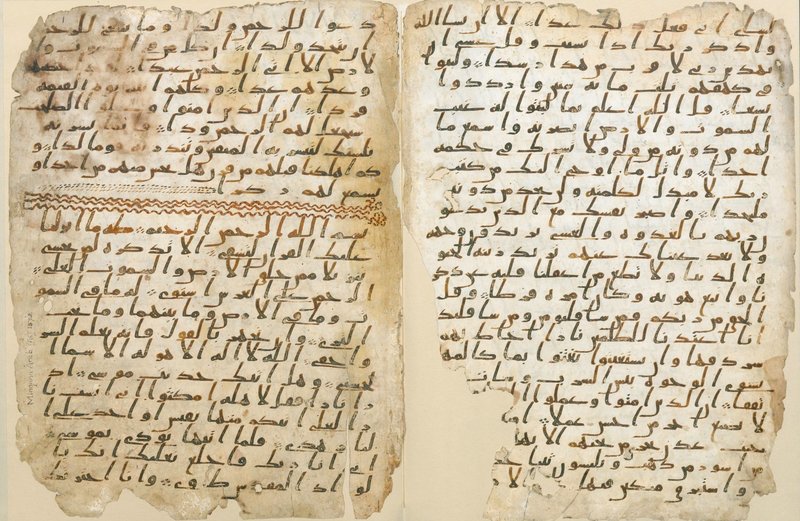
In this section of the exhibit, we trace the evolution of Arabic writing as seen in Quranic manuscripts. The first of these manuscripts is known as the Birmingham Quran, which has been carbon-dated to the 7th Century, i.e. the first century of Islam (1). This early manuscript contains letters that are both tightly crammed onto the page and diagonally slanted. The diagonal slant is indicative of the so-called "Hijazi" script (2), and the crammed nature of the letters indicates a concern for practicality and parchment preservation on the part of the scribe.
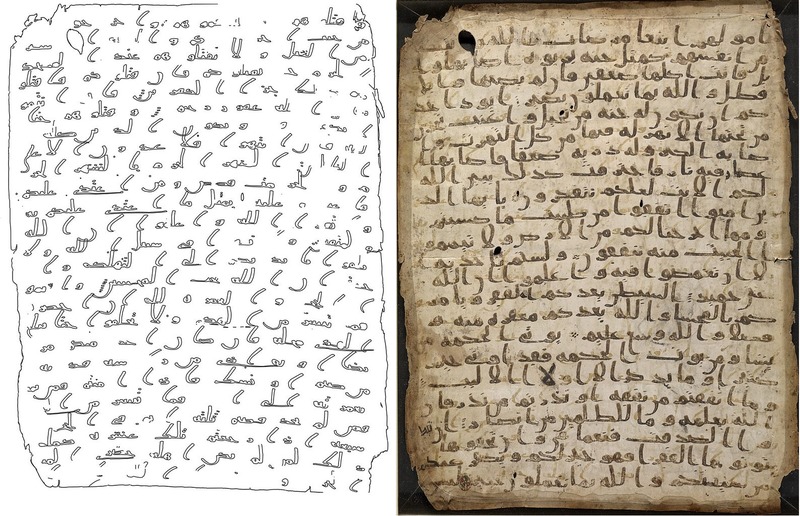
This second manuscript is known as the Sana’a palimpsest. Being a palimpsest, this folio contains two layers of text – the visible layer on top, and a lower layer that has been written over. In the picture, the older, covered text, which has been dated to the 7th Century and accessed via X-ray analysis, appears on the left. The more recent, though still old, covering text is shown on the right (3). With this artifact, we get a direct look at the evolution of Arabic writing. The older text includes diagonally slanted characters, much like those seen on the Birmingham manuscript. The replacement text, though, lacks the diagonal characters, allowing us to infer that the diagonally-slanted Hijazi script had by then gone out of fashion. Note, however, that the words are still crammed tightly in the newer text. For early Quranic scribes, the mere notation of God’s word was enough. Artistry would come later.
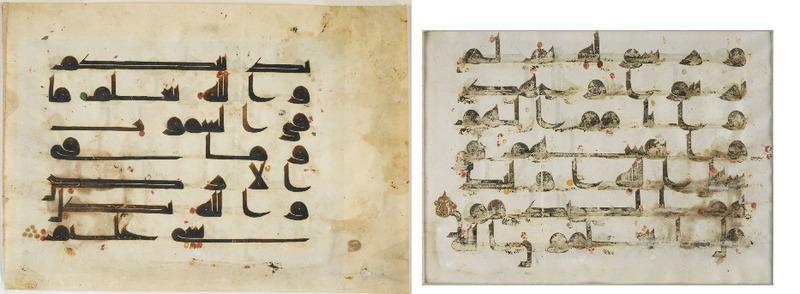
Said artistry is on full display in the Kufic folio depicted on the left. In this 9th Century folio (4), the words clearly and purposefully do not fill up the entire page. Instead, an attractive minimalism pervades the piece. The vibrant and elegant markings evince conscious artistry, and are written to glorify God. The extreme elongation of the characters – an identifiably Kufic characteristic – gave the scribe the flexibility he needed in order to neatly fit and elegantly space the words within a precisely defined rectangular area.
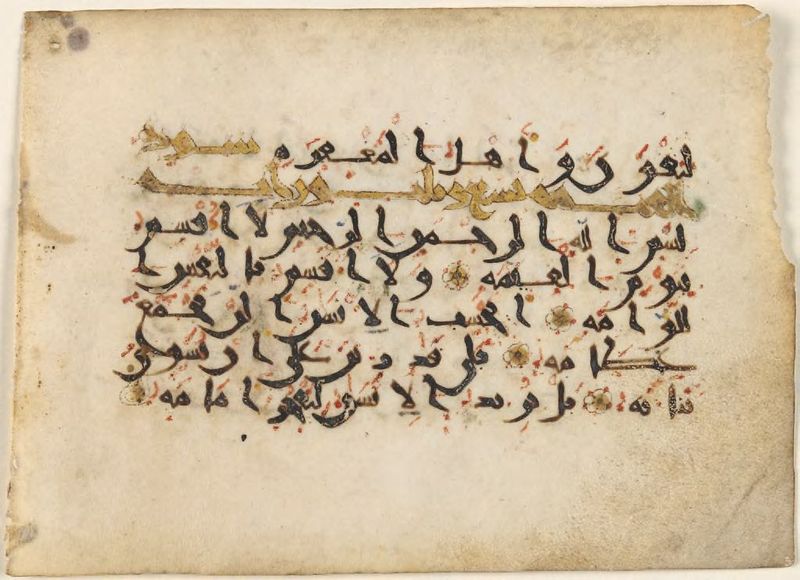
This final manuscript folio dates to the 10th Century and is indicative of what came after the Kufic style (5). This text, while still being fit into a rather precisely defined rectangle, and while still containing “stretchable” horizontal lines, lacks the elegant spacing present in the above Kufic manuscript. Furthermore, the text is more curved than the jagged, angular Kufic.
(1) "Birmingham Qur'an Manuscript Dated among the Oldest in the World." News and Events. University of Birmingham, 22 July 2015. Web. 11 Dec. 2016.
(2) Korn, Hannah. "Scripts in Development." The Metropolitan Museum of Art, I.e. The Met Museum. The Metropolitan Museum of Art, 28 June 2012. Web. 11 Dec. 2016.
(3) "Codex Sana'a I - A Qur'anic Manuscript From Mid-1st Century Of Hijra." Codex Sana'a I - A Qur'anic Manuscript From Mid-1st Century Of Hijra. Islamic Awareness, 27 Mar. 2012. Web. 11 Dec. 2016.
(4) Harvard. "Folio from a Qur'an: Sura 49: Mid 15 - Begin 16 (recto), Sura 49: 16 (verso)." From the Harvard Art Museums' Collections. Harvard Art Museums, n.d. Web. 11 Dec. 2016.
(5) Harvard. "Folio from a Qur'an." From the Harvard Art Museums' Collections. Harvard Art Museums, n.d. Web. 11 Dec. 2016. <http://www.harvardartmuseums.org/collections/object/336992?position=103>.