Folio from a Kufic Quran
Dublin Core
Title
Folio from a Kufic Quran
Folio from a Kufic Quran
Description
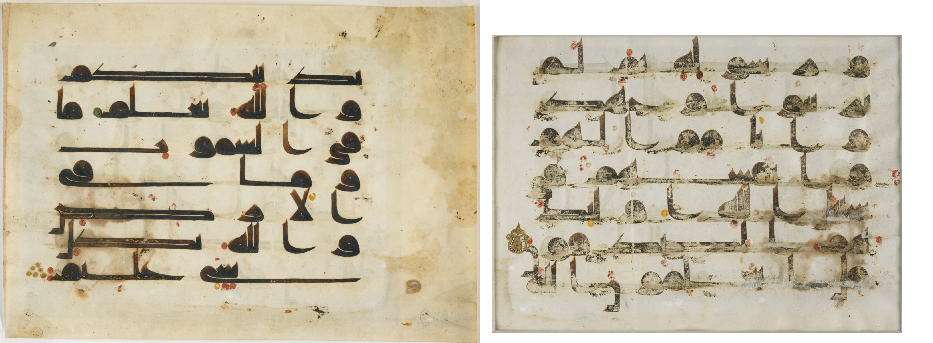
This folio contains part of Chapter 49, Verse 15, and the entirety of Verse 16. In the descriptions below we simply refer to it as "the 49:16 folio."
Source
http://www.harvardartmuseums.org/collections/object/193807?q=1956.197
Date
9th Century
Contributor
Dan LaPointe
Format
Ink and gold on parchment
Language
Arabic
MOL Object Item Type Metadata
What is it?
This folio is a page out of an early Quran. The text, crafted in the early Kufic style, is made out of black ink and is written on parchment (1956.197). The dimensions of the folio are 23.1 x 32.5 cm, despite the claim on the Harvard Art Museum’s website that the dimensions are 18.2 x 25.9 cm. These revised dimensions put the folio within the size range of other similar looking folios that likely come from the same Quran. These folios can be found in the Harvard (2011.494), Princeton (1958-110), and Los Angeles County (M.73.5.502) Art Museums, and also at the Smithsonian Freer Collection (F1930.23).
Looking at the two sides of the folio, one is immediately struck by how different the recto (right) and verso (left) sides look. While the verso side is smooth and vivid, the recto side is rough and faded. This makes sense given that the material is parchment, and that every page of parchment comes with a “hairy” side (Schimmel 4) that, unless very carefully prepared, is of inferior quality. This phenomenon – the presence of a beautifully preserved side and a terribly preserved side – is particularly common in early Quranic manuscripts (Schimmel 4).
Moving on from the parchment, we may observe the physical properties of the text. The bulk of the markings on this page are in black ink which, on the verso side at least, has been remarkably well preserved. In addition to the black markings, we see red, yellow, green, and gold dots. The gold dots, located in the lower left corner of the verso side, indicate the end of a verse (Baker 22). The red, yellow, and green dots serve a subtler purpose - the notation of vowels.
Finally, we may translate the text's content. From the beginning of the recto side we have the ending of Sura 49, Verse 15: “…and His Messenger and then doubt not but strive with their properties and their lives in the cause of Allah. It is those who are the truthful (Al-Hujurat 49:15).” At this point the text reaches a peculiar marking indicating the end of a fifth verse. From there we read Verse 16, which continues onto and rounds out the verso side: “Say, would you acquaint Allah with your religion while Allah knows whatever is in the heavens and whatever is on the earth, and Allah is Knowing of all things?” (Al-Hujurat 49:16).
Looking at the two sides of the folio, one is immediately struck by how different the recto (right) and verso (left) sides look. While the verso side is smooth and vivid, the recto side is rough and faded. This makes sense given that the material is parchment, and that every page of parchment comes with a “hairy” side (Schimmel 4) that, unless very carefully prepared, is of inferior quality. This phenomenon – the presence of a beautifully preserved side and a terribly preserved side – is particularly common in early Quranic manuscripts (Schimmel 4).
Moving on from the parchment, we may observe the physical properties of the text. The bulk of the markings on this page are in black ink which, on the verso side at least, has been remarkably well preserved. In addition to the black markings, we see red, yellow, green, and gold dots. The gold dots, located in the lower left corner of the verso side, indicate the end of a verse (Baker 22). The red, yellow, and green dots serve a subtler purpose - the notation of vowels.
Finally, we may translate the text's content. From the beginning of the recto side we have the ending of Sura 49, Verse 15: “…and His Messenger and then doubt not but strive with their properties and their lives in the cause of Allah. It is those who are the truthful (Al-Hujurat 49:15).” At this point the text reaches a peculiar marking indicating the end of a fifth verse. From there we read Verse 16, which continues onto and rounds out the verso side: “Say, would you acquaint Allah with your religion while Allah knows whatever is in the heavens and whatever is on the earth, and Allah is Knowing of all things?” (Al-Hujurat 49:16).
Why was it made?
Before answering this question we must make an important observation. Take a look at the leftmost (last) word of the top line of the verso side: nikum. The two small vertical lines at the beginning give us the nun character, and its associated “n” sound (Khan 78). The two horizontally stretched lines with the diagonal uptick at the end mark the Kufic kaf and provide us with the “k” sound (Khan 73). Finally, the rounded symbol at the end of the word is the mim character, which indicates an “m” sound (Khan 77). Putting all of this together we have the word “nkm.” Noticeably, the vowels are missing. This phenomenon was common in early Qurans. Nevertheless, scribes made modest efforts to clear up the meanings of certain ambiguous words. Hence the colored dots denoting vowel sounds (Baker 20).
Note, however, that the colored dots don’t account for nearly all of the necessary vowel markings. The aforementioned "nkm" was assumed to be enough to jog the reader’s memory. This suggests something important regarding this manuscript – its main purpose was to aid the reader in reciting something he already knew. The Quran, like almost everything else in Arab culture, had a rich history of oral transmission. Memorizing the spoken word was what really mattered. These early books were meant to facilitate that process.
Note, however, that the colored dots don’t account for nearly all of the necessary vowel markings. The aforementioned "nkm" was assumed to be enough to jog the reader’s memory. This suggests something important regarding this manuscript – its main purpose was to aid the reader in reciting something he already knew. The Quran, like almost everything else in Arab culture, had a rich history of oral transmission. Memorizing the spoken word was what really mattered. These early books were meant to facilitate that process.
Who made it?
The 49:16 folio, and all of the other folios that have been mentioned, are unsigned. This doesn’t mean that their Quran as a whole is unsigned (after all, it wouldn’t make much sense for the scribe to place his signature in the middle of the book). Regardless, the writers of most early Kufic Qurans are unknown (Schimmel 6). This may reflect a number of different phenomena: poor preservation of pages containing signatures, an actual tradition of not signing Qurans, production by numerous scribes in a workshop rendering attribution irrelevant, etc.
Regardless, we may still wonder what sort of person would have penned the 49:16 folio. Scribes came from a variety of backgrounds; any sufficiently promising youth in the city could, in theory, rise through the ranks and become a calligrapher. Nevertheless, most scribes came from certain families with a history in the practice (Bennison 100). A potential scribe would start learning how to write in his early years, usually at the age of eight or nine (Schimmel 46), and would all the while train under a master. After reaching a certain level of skill, usually in his twenties, the student would become a bona fide scribe, and would be granted permission to work (Schimmel 36).
Regardless, we may still wonder what sort of person would have penned the 49:16 folio. Scribes came from a variety of backgrounds; any sufficiently promising youth in the city could, in theory, rise through the ranks and become a calligrapher. Nevertheless, most scribes came from certain families with a history in the practice (Bennison 100). A potential scribe would start learning how to write in his early years, usually at the age of eight or nine (Schimmel 46), and would all the while train under a master. After reaching a certain level of skill, usually in his twenties, the student would become a bona fide scribe, and would be granted permission to work (Schimmel 36).
Where was it produced?
The information on the Harvard Art Museum’s website suggests that this folio was produced in Iraq (1956.197). Kufa, the city from which the Kufic script acquired its name, is located in Iraq, and it would certainly make sense if the 49:16 folio came from that influential city. Interestingly, the Princeton Art Museum’s website claims that its folio, which almost certainly comes from the same place as the 49:16 folio, is Egyptian (1958-110). Perhaps this label refers to where the folio was acquired – i.e. after being written in Kufa it could have ended up in an Egyptian bazaar. Or maybe the label indicates that the manuscript was indeed written in Egypt. With only this information, however, the origin of this manuscript cannot be deduced.
Where did it go?
Since the exact origins of the folio are unclear, it wouldn’t make much sense to tell a chronological story of where it went. Instead, let us work backwards. According to the Harvard Art Museum’s website, this folio was acquired as an “Anonymous Gift in memory of Rudolph Meyer Riefstahl” in 1956, a full twenty years after Riefstahl had died (1956.197). The anonymous donor was almost certainly his wife Elizabeth. In September of 1956 she had retired from her job in Brooklyn and moved to live with her daughter in South Essex (Guzman 8). This folio, along with a page from an Ottoman manuscript (1956.196), may very well have been Elizabeth’s gift to her new home the Boston area.
At this point it’s worth noting the provenance of three other folios that have been mentioned. Princeton acquired its folio in 1958 (1958-110). While the website doesn’t state explicitly where the page came from, an Ottoman folio donated at the same exact time (judging by the classification numbers) was gifted in Rudolph Riefstahl’s name (1958-111). This suggests that Elizabeth was once again responsible. The second Harvard folio was acquired from the Los Angeles County Museum of Art in 2011 (which is, perhaps less than coincidentally, the location of the thrid folio), and can “probably” be traced back to Rudolph Riefstahl (2011.494).
If all of these folios can be traced back to Rudolph and Elizabeth Riefstahl, a question then arises: did they own the entire Quran that these folios came from? Probably not – it wouldn’t make a whole lot of sense for Elizabeth to rip out and anonymously donate one page of a manuscript to an art museum when there’s a library devoted to collecting old books (Houghton) right around the corner. Instead, the Riefstahls likely bought a few pages from a dealer in the Middle East who may have had access to the entire Quran, and who, in order to boost profits, decided to sell it one page at a time. Tracing the history of the folio back any further than this is next to impossible.
At this point it’s worth noting the provenance of three other folios that have been mentioned. Princeton acquired its folio in 1958 (1958-110). While the website doesn’t state explicitly where the page came from, an Ottoman folio donated at the same exact time (judging by the classification numbers) was gifted in Rudolph Riefstahl’s name (1958-111). This suggests that Elizabeth was once again responsible. The second Harvard folio was acquired from the Los Angeles County Museum of Art in 2011 (which is, perhaps less than coincidentally, the location of the thrid folio), and can “probably” be traced back to Rudolph Riefstahl (2011.494).
If all of these folios can be traced back to Rudolph and Elizabeth Riefstahl, a question then arises: did they own the entire Quran that these folios came from? Probably not – it wouldn’t make a whole lot of sense for Elizabeth to rip out and anonymously donate one page of a manuscript to an art museum when there’s a library devoted to collecting old books (Houghton) right around the corner. Instead, the Riefstahls likely bought a few pages from a dealer in the Middle East who may have had access to the entire Quran, and who, in order to boost profits, decided to sell it one page at a time. Tracing the history of the folio back any further than this is next to impossible.
When was it made?
The Harvard Art Museum's website dates this folio to the 9th Century (1956.197). By modern standards, dating something within a hundred-year time span isn’t very good. By medieval standards, though, this date is rather precise. How is it that we are able to achieve this level of accuracy? A few factors can give us information relating to when this manuscript was made - namely, the style of the writing, and the fact that the manuscript is made of parchment.
This manuscript, as was stated earlier, was written in the early Kufic style. Said style – which is remarkably distinct, with its large, bold, horizontally stretched letters – was one of the first Arabic calligraphic forms to develop. The Kufic style reached its peak in the 9th century and 10th Centuries (Baker 18), and for this reason we are able to date manuscripts written in this form.
But how did we manage to figure out when the Kufic style was around in the first place? That the bulk of Kufic manuscripts – including the 49:16 folio – were written on parchment (Schimmel 4) is telling. For a long time, parchment was the default material on which scribes would write. Only later, following the Battle of Talas in 751, and the slow westward spread of papermaking thereafter, would papermaking become popular. But once paper caught on, parchment fell almost completely out of use. Any manuscript written on parchment, therefore, must have been around before paper became the default that it is today.
This manuscript, as was stated earlier, was written in the early Kufic style. Said style – which is remarkably distinct, with its large, bold, horizontally stretched letters – was one of the first Arabic calligraphic forms to develop. The Kufic style reached its peak in the 9th century and 10th Centuries (Baker 18), and for this reason we are able to date manuscripts written in this form.
But how did we manage to figure out when the Kufic style was around in the first place? That the bulk of Kufic manuscripts – including the 49:16 folio – were written on parchment (Schimmel 4) is telling. For a long time, parchment was the default material on which scribes would write. Only later, following the Battle of Talas in 751, and the slow westward spread of papermaking thereafter, would papermaking become popular. But once paper caught on, parchment fell almost completely out of use. Any manuscript written on parchment, therefore, must have been around before paper became the default that it is today.
How was it used?
The wide margins and large script indicate a disregard for efficiency; whoever ordered the production of this Quran worried little about the cost of parchment. Indeed, this particular Quran might have been part of a multi-volume set. Thirty volume sets in particular became popular around this time (Baker 30). All of this suggests that this Quran may have been commissioned and purchased by a relatively wealthy individual. The buyer would have kept the manuscript in his home and would have taken it out periodically to help him pray (Baker 30). Assuming this life story for the 49:16 folio, the remarkable preservation of the ink makes sense – whoever owned this manuscript cherished it and handled it with care.
If one is willing to abandon this “private owner” hypothesis, however, an intriguing alternative becomes available. It is known that during this time period the city of Kufa (a proposed creation place for this manuscript) had a boisterous school that taught hundreds of children how to read (Bennison 163). This Quran, with its incredibly large and bold script, may have also fit well in a classroom setting.
If one is willing to abandon this “private owner” hypothesis, however, an intriguing alternative becomes available. It is known that during this time period the city of Kufa (a proposed creation place for this manuscript) had a boisterous school that taught hundreds of children how to read (Bennison 163). This Quran, with its incredibly large and bold script, may have also fit well in a classroom setting.
How was it made?
Creating this folio, and the entire manuscript of which it was a part, would have been no small task. Producing a single Quran would have required parchment, ink, qalams (writing utensils), and paid scribal labor.
Parchment was made from the stretched and dried skin of dead animals. The slaughtered animal in this case may have been a goat, or perhaps a young calf (Blair 73). Parchment produced from the skin of calves was valued for its smooth texture, and was known in the Western world as “vellum.” Note that the Princeton Art Museum’s website describes its folio, which likely comes from the same Quran as the 49:16 manuscript, as being written on vellum (1958-110). The remarkable quality of the verso side of these folios may corroborate this fact.
The black ink, meanwhile, would have been produced from ground-up carbon, i.e. charcoal (Khan 23). The qalam would have been made out of a roughly ten-inch-long cut of the Arundo donax plant, a species of giant reed (Khan 22), and the actual writing of this manuscript would have taken place in a workshop with numerous scribes collectively toiling away at the Quran’s many verses (Khan 15).
Parchment was made from the stretched and dried skin of dead animals. The slaughtered animal in this case may have been a goat, or perhaps a young calf (Blair 73). Parchment produced from the skin of calves was valued for its smooth texture, and was known in the Western world as “vellum.” Note that the Princeton Art Museum’s website describes its folio, which likely comes from the same Quran as the 49:16 manuscript, as being written on vellum (1958-110). The remarkable quality of the verso side of these folios may corroborate this fact.
The black ink, meanwhile, would have been produced from ground-up carbon, i.e. charcoal (Khan 23). The qalam would have been made out of a roughly ten-inch-long cut of the Arundo donax plant, a species of giant reed (Khan 22), and the actual writing of this manuscript would have taken place in a workshop with numerous scribes collectively toiling away at the Quran’s many verses (Khan 15).
Material Composition
Ink and gold on parchment
Functional Category
Manuscript
Rights
http://www.harvardartmuseums.org/collections/object/193807?q=1956.197
Identifier
1956.197
Sources and Further Reading
Baker, Colin F. Qur'an Manuscripts: Calligraphy, Illumination, Design. London: British Library, 2007. Print.
Bennison, Amira K. The Great Caliphs: The Golden Age of the 'Abbasid Empire. New Haven: Yale UP, 2009. Print.
Blair, Sheila S. "Transcribing God's Word: Qur'an Codices in Context." Journal of Qur'anic Studies 10.1 (2008): 72-97. Web. 10 Oct. 2016.
Guzman, Diane. "Women in Old World Archaeology." Women in Old World Archaeology. Brown University, n.d. Web. 11 Nov. 2016.
Khan, Gabriele Mandel. Arabic Script: Styles, Variants, and Calligraphic Adaptations. New York: Abbeville, 2001. Print.
N.d. MS 1956.196, Harvard Art Museum. Harvard University. Web. 10 Oct. 2016.
N.d. MS 1956.197, Harvard Art Museum. Harvard University. 10 Oct. 2016.
N.d. MS 2011.494, Harvard Art Museum. Harvard University. Web. 10 Oct. 2016.
N.d. MS M.73.5.502, Los Angeles County Museum of Art. Web. 10 Oct. 2016.
N.d. MS 1958-110, Princeton University Art Museum. Princeton University. Web. 10 Oct. 2016.
N.d. MS 1958-111, Princeton University Art Museum. Princeton University. Web. 10 Oct. 2016.
N.d. MS F1930.23, Freer Gallery of Art. Smithsonian Institution. Web. 10 Oct. 2016.
Schimmel, Annemarie. Calligraphy and Islamic Culture. New York: New York UP, 1984. Print.
"Al-Hujurat." Quran. N.p., n.d. Web. 11 Nov. 2016.
Bennison, Amira K. The Great Caliphs: The Golden Age of the 'Abbasid Empire. New Haven: Yale UP, 2009. Print.
Blair, Sheila S. "Transcribing God's Word: Qur'an Codices in Context." Journal of Qur'anic Studies 10.1 (2008): 72-97. Web. 10 Oct. 2016.
Guzman, Diane. "Women in Old World Archaeology." Women in Old World Archaeology. Brown University, n.d. Web. 11 Nov. 2016.
Khan, Gabriele Mandel. Arabic Script: Styles, Variants, and Calligraphic Adaptations. New York: Abbeville, 2001. Print.
N.d. MS 1956.196, Harvard Art Museum. Harvard University. Web. 10 Oct. 2016.
N.d. MS 1956.197, Harvard Art Museum. Harvard University. 10 Oct. 2016.
N.d. MS 2011.494, Harvard Art Museum. Harvard University. Web. 10 Oct. 2016.
N.d. MS M.73.5.502, Los Angeles County Museum of Art. Web. 10 Oct. 2016.
N.d. MS 1958-110, Princeton University Art Museum. Princeton University. Web. 10 Oct. 2016.
N.d. MS 1958-111, Princeton University Art Museum. Princeton University. Web. 10 Oct. 2016.
N.d. MS F1930.23, Freer Gallery of Art. Smithsonian Institution. Web. 10 Oct. 2016.
Schimmel, Annemarie. Calligraphy and Islamic Culture. New York: New York UP, 1984. Print.
"Al-Hujurat." Quran. N.p., n.d. Web. 11 Nov. 2016.
Files
Citation
“Folio from a Kufic Quran,” CB 51 Omeka, accessed August 6, 2026, https://cb51-16.omeka.fas.harvard.edu/items/show/245.