Ceramics
Unlike the rest of the objects thus far presented, the following ceramics come from the eastern edge of the Islamic world. Each of these ceramics was produced under the Samanids in what is now Iran. A further difference between these ceramics and the rest of the exhibit’s objects can be seen in the text itself. Whereas the words on all of the previous objects have dealt with solemn religious invocation, the ceramics below contain charming aphorisms. Even in this more casual domestic setting, however, we find that Kufic form follows decorative function.
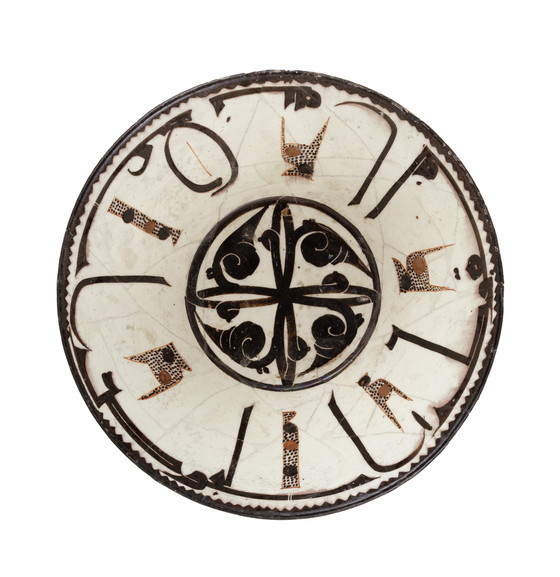
This bowl, decorated with what appear to be animals, additionally contains a circle of text on its outer edge. Writing the text in this manner is impossible without the horizontal elongation of letters which the Kufic style conveniently provides. We may also note the extreme vertical elongation of some of the letters. This allows the bowl’s decoration to appear more balanced; wherever there aren’t any animals, vertically elongated letters fill in. Reading the text yields a simple aphorism: “Greed is a sign of poverty" (1).
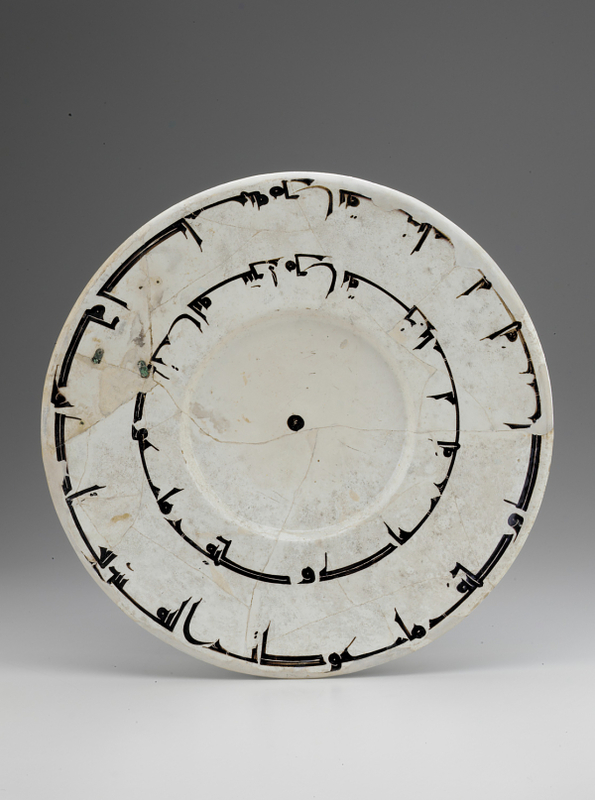
This bowl contains two circles of text. Interestingly, both circles contain the same message, with additional text appearing on the larger circle in order to account for its larger circumference. Note that this compensatory text in the larger circle wouldn’t have been necessary if the Kufic style were completely flexible – if so, the words now taking up two thirds of the larger circle could have been stretched to fit the entire circle. This suggests that, even in the highly flexible Kufic style, there were basic aesthetic limits governing how far the stretching of letters could go. The text, in this case, reads, “He who believes in recompense is generous in giving, and to whatever you accustom yourself, you will grow accustomed" (2).
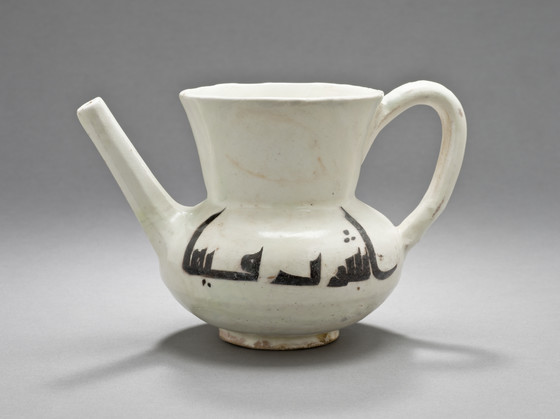
For the final object in this exhibit I leave you with a small ewer. This object, given its size and design, was meant to be drunken from directly. Its owner would have had countless encounters with it, and upon each of these encounters, he would have read the same bit of Kufic text: “Drink from it/ Cheers" (3). That so banal an inscription existed on so banal an object is a testament to the then-ubiquity of the Kufic style.
(1) "Bowl with Epigraphic and Vegetal Decoration." LACMA Collections. Los Angeles County Museum of Art, 2016. Web. 11 Dec. 2016.
(2) "Open F|S: Plate." Freer | Sackler. Smithsonian Institution, n.d. Web. 11 Dec. 2016. <http://www.asia.si.edu/collections/edan/object.php?q=fsg_F1952.11>.
(3) "Ewer." LACMA Collections. Los Angeles County Museum of Art, n.d. Web. 11 Dec. 2016. <http://collections.lacma.org/node/187813>.