Coins
Coins, insofar as they are widespread, durable, and datable, provide excellent information regarding the evolution of writing. Islamic coins, by featuring only text, serve this purpose even better. In this section of the exhibit, we watch the Kufic style evolve right before our eyes.
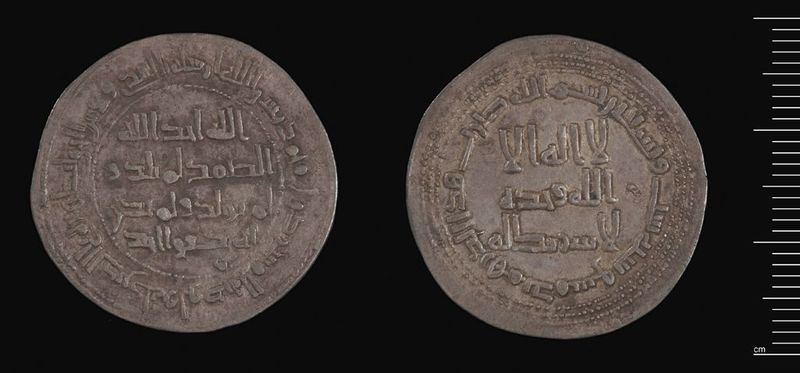
This first coin was minted under the Umayyad dynasty in the year 715 (1). Both sides of the coin have regular text inscribed within a circle of text. The angular, jagged nature of the letters is clearly visible, though the horizontal stretch factor seen in other Kufic inscriptions seems to be lacking. With this coin, we see an incredibly well thought-out design. The circle on the left, for example, was completed without stretching any of the letters.
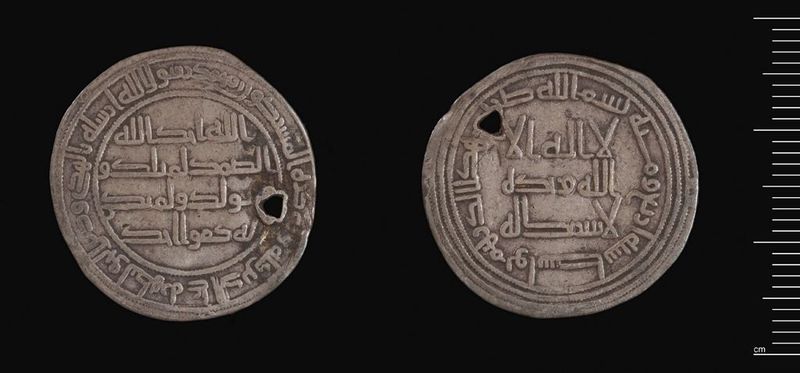
In this second coin, which circulated just seven years later, still under the reign of the Umayyads (2), we see a noteworthy change. The kaf character (3) has all of the sudden been elongated. In this particular coin, the designer seems to have opted for a denser block of "incircle" text, especially on the side shown on the left. The freely mutable kafs, which have clearly been stretched to varying degrees on the left side, allowed the designer to achieve this.
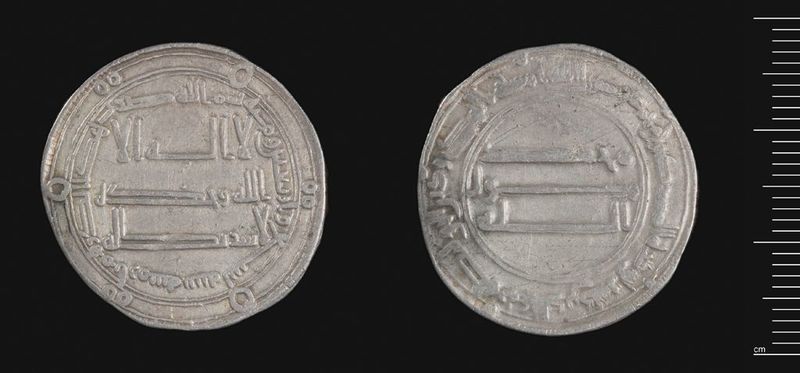
This next coin dates to 755, and circulated under the reign of Abbasid caliph al-Mansur (4). Whereas the first two coins contain identical "incircle" text, this Abbasid coin makes significant changes. Quite notably, it contains fewer words, and accordingly stretches its letters to a greater extent. Indeed, the elongation visible on the side shown on the right has been taken to an almost absurd degree. This, however, is typical of Abbasid coins. Given that the Abbasids had just come into power five years before this coin’s minting, the change in style is understandable. Old Umayyad coins may have still been circulating, and the Abbasid caliphs, in order to distinguish themselves from the ousted Umayyads, made a conscious alteration of style. In this way, written style made a political statement.
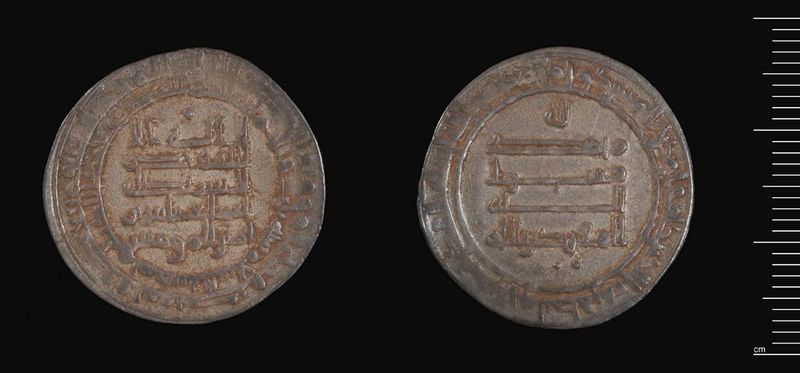
This next coin, dated to 916, though still circulating under Abbasid rule (5), is in some ways different from the al-Mansur coin. This coin contains significantly more text, and has two circles of text on the left one side of the coin. Nevertheless, extreme elongation is visible in some of the letters, particularly those on the side shown on the right. This characteristic, despite all of the other changes, seems to have been a constant under Abbasid rule.
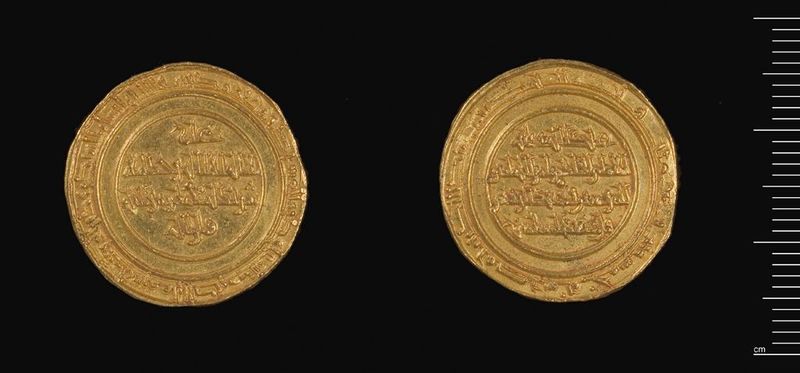
This last coin was minted in 1015, and circulated under Fatimid rule (6). Of all the coins in this exhibit, it is the only one to not have its inscriptions written in Kufic. This coin’s text clearly lacks the elongated characters seen in the Abbasid coins above. More importantly, the text is far more curved than anything that has been seen on any of the coins thus far. In this way, the text more closely resembles that seen in the last of this exhibit’s manuscripts.
(1) "Dirham of Sulayman,Damascus." From the Harvard Art Museums' Collections. Harvard Art Museums, n.d. Web. 11 Dec. 2016.
(2) "Dirham of Yazid II, Wasit." From the Harvard Art Museums' Collections. Harvard, n.d. Web. 11 Dec. 2016.
(3) "Arabic Alphabet." Encyclopedia Britannica Online. Encyclopedia Britannica, 18 Aug. 2016. Web. 11 Dec. 2016.
(4) "Dirham of Al-Mansur." From the Harvard Art Museums' Collections. Harvard Art Museums, n.d. Web. 11 Dec. 2016.
(5) "Dirham of Al-Muqtadir, Madina-t Al-Salam (Baghdad)." From the Harvard Art Museums' Collections. Harvard Art Museums, n.d. Web. 11 Dec. 2016.
(6) "Dinar of Al-Hakim, Misr." From the Harvard Art Museums' Collections. Harvard Art Museums, n.d. Web. 11 Dec. 2016.