Censers of the Wealthy
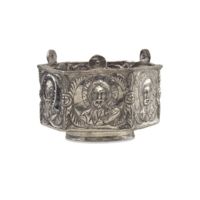
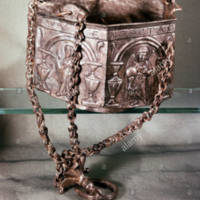
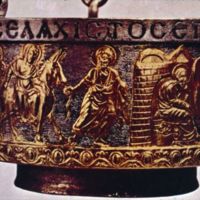
These censers offer a stark contrast to those previously explored. All made of silver, they were presumably used only by those who could afford them. Rendered in relief with much greater detail, these censers demonstrate the luxuries of wealth. The Cyrpus Treasure censer depicts detailed faces of Christ, Peter, and Paul.1 In addition to more complex style, this fact also demonstrates a change in scenery. While common censers relied on crudely designed objects and symbols to convey their scenes, this censer exhibits distinguishable faces, perhaps demonstrating what money can buy. The prevalence of these more expensive censers is also much less, suggesting that detail and quality were prioritized over the ability to be mass-produced.
These objects were presumably used not only by the wealthy, but also by churches with sufficient funds. As religious services aimed to revere Christ in all ways possible, it makes sense that able churches would have had silver (and possibly gold) liturgical items, including censers. However, despite far greater aesthetic appeal, these censers, once again, were used for exactly the same purpose by rich and poor alike. Each party had the ultimate goal of communicating with the Lord and other holy figures. Additionally, the use of such detailed censers in churches might have offered psychological benefit to laypeople in that they may believe that God views them more favorably in the presence of a nicer, more expensive instrument of worship (i.e. a silver censer). Overall, however, these censers and others brought people together, whether physically (at church) or spiritually, across social classes and generations alike and promoted Christian worship throughout the Middle Ages.
1. ———. "Silver Censer from the First Cyprus Treasure." The
British Museum. Accessed December 6, 2016.
http://culturalinstitute.britishmuseum.org/asset-viewer/
silver-censer-from-the-first-cyprus-treasure/jQHmlkURqhlPWw?hl=en.
2. Byzantine Hexagonal Censer. Photograph. Alamy. Accessed December 6, 2016.
http://www.alamy.com/
stock-photo-fine-arts-byzantine-art-hexagonal-censer-silver-relief-constantinople
-19748462.html.
3. Censer discovered near Finike. Photograph. http://hollis.harvard.edu.