Common Censers
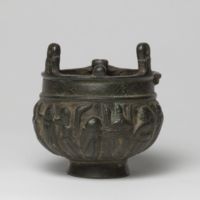
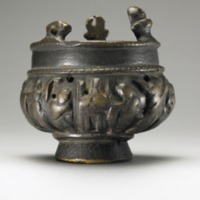
These censers offer examples of household censers from the 7th and 8th centuries. They bear crude depictions of scenes from the life of Christ, rendered in high relief.1 Constructed of bronze and most likely originating from the Holy Land, these censers represent common censers owned and used by ordinary people.4 Their similar styles provide evidence of similar origin and casting. The different images found on the undersides of these censers could just be additions meant to individualize the censers.
Consistent style across the four censers demonstrates a persistent Christian influence between the 6th and 9th centuries. Additionally, similar style, despite slight iconographic differences, offers a link between generations, as these censers were created across several centuries. As items from the Holy Land were commonly obtained through pilgrimage, the reappearance of these censers across centuries also demonstrates the continuity of pilgrimage and immersion in faith.
1. President and Fellows of Harvard College. "Lamp or Censer with Scenes from the
Life of Christ." Harvard Art Museums. Accessed October 24, 2016.
http://www.harvardartmuseums.org/art/215371.
2. The Walters Art Museum. "Censer with Scenes from the Life of Christ." The
Walters Art Museum. Accessed December 7, 2016. http://art.thewalters.org/
detail/27283/censer-with-scenes-from-the-life-of-christ/.
3. Museum of Fine Arts, Boston. "Censer." Museum of Fine Arts, Boston. Accessed
December 7, 2016. http://www.mfa.org/collections/object/censer-55014.
4. Gonosova, Anna, and Christine Kondoleon. "Censer." In Art of Late Rome and
Byzantium, 274-77. Richmond: Virginia Museum of Fine Arts, 1994.
5. The Trustees of Princeton University. "Censer with New Testament Scenes."
Princeton University Art Museum. Accessed December 7, 2016.
http://artmuseum.princeton.edu/collections/objects/21927.