Liturgical Censers
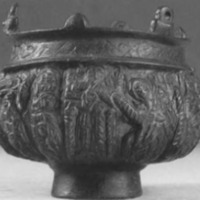
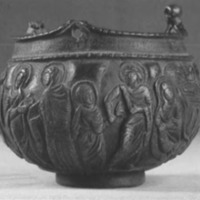
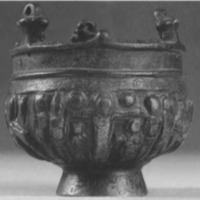
These 13th century liturgical censers hail from the Turkish city of Ani. They bear structural resemblance to the common censers displayed, but exhibit increased detail in style. Each censer depicts 2-3 more scenes than common censers. This, in turn, requires that the censers be larger as well. This change can possibly be attributed to changes in artistic focus, brought about by the impending Renaissance. Additionally, the brass composition of these censers demonstrates a need for additional aesthetic appeal in church settings. Compared to bronze, brass was/is used as a decorative element because of its resemblance to gold.
Outside of material differences, these censers draw a link between the early and late Middle Ages by way of stylistic continuity (e.g. common scenes from the life of Christ). The Annunciation, Nativity, and Crucifixion, especially, remain as prominent scenes, while new scenes, such as the Visit of the Magi, are introduced perhaps out of changes in preference, as well as a desire for a more complete representation of Christ's life.
As these censers were used in church services, a link can also be established between the common people and the church. Despite being made of brass instead of bronze, these censers still served the same purpose as common censers: to burn incense as a means of amplifying prayer.3 Neither brass nor other more precious metals added any significant benefit to a censer. It was simply for visual appeal. Thus, censers used in churches were simply used in a more direct context, as priests were typically nearer to God than laypeople.
1. Nersessian, Vrej. "Censers." In Treasures from the Ark: 1700 Years of Armenian
Christian Art, 123. N.p.: Getty Publications, 2001.
2. Metal Supermarkets. "Difference between Copper, Brass, and Bronze." Metal
Supermarkets. Last modified April 21, 2015. Accessed December 8, 2016.
https://www.metalsupermarkets.com/difference-between-copper-brass-bronze/.
3. Kalavrezou, Ioli. "Lamp/Incense Burner with Scenes from the Life of Christ." In
Byzantine Women and Their World, 202. Cambridge: Harvard University Art
Museum, 2003.