Cassoni
Another development that occurred in 14th century Italy is the popularization of cassoni, which are marriage chests purchased by wealthy families for the newly married couple. The commission of a cassone was intentionally a celebratory and ostentatious gesture. Following the wedding ceremony, the new couple would parade around the city in order to present the two families' triumphs: the family as a whole got to display its wealth, the couple asserted their elevated social and political status as a pair, and the husband would show off his prize of a bride.[1] The weddings, in fact, took on a similar status to military victories in the Roman and Byzantine eras. Many of the cassoni employed Petrarch's Trionfi in order to express this celebratory sentiment.
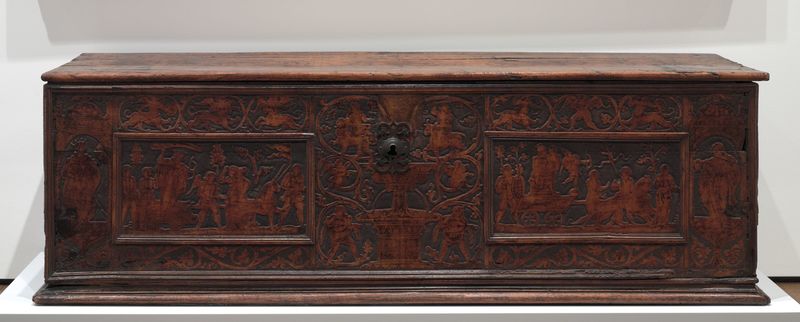
This first cassone, intricately carved out of walnut, features relatively large figures of Petrarch's Triumphs of Love and Chastity on opposite ends of the front face. Also depicted are Roman chariot riders, which simultaneously symbolizes the victory of a marriage and the contemporary admiration of Rome.
This next chest, like most cassoni conserved today, instead features painted panels.[2] It is true that cassoni exhibited a wide variety of artistic techniques, yet they were also functional and symbolic pieces of furniture. Thus the curious aspect about this particular cassone is that it features all of Petrarch's "Triumphs," rather than the two that are most obviously related to marriage. The effect of this is ultimately to strengthen the impact of the theme, as well as protect the couple's marriage even in death. Petrarch himself had lost his muse, Laura, prior to completing I Trionfi, and some scholars suggest that the final triumph of Eternity allows for his spiritual reunion with her.[3] Consequently, Petrarch's Trionfi as they appeared on cassoni offered marriages everlasting victory.
[1] Grange, Susan, "The Cassone – the Renaissance ‘bottom Drawer’," Isabella Stewart Gardner Museum, accessed April 03, 2016.
[2] Oxford University Press, "Cassone," Grove Encyclopedia of Medieval Art and Architecture, 2013, accessed April 3, 2016.
[3] Alessandro Cane, "I 'Trionfi' di Petrarca: riassunto e commento."