The Man of Sorrows
Dublin Core
Title
The Man of Sorrows
The Man of Sorrows
Description
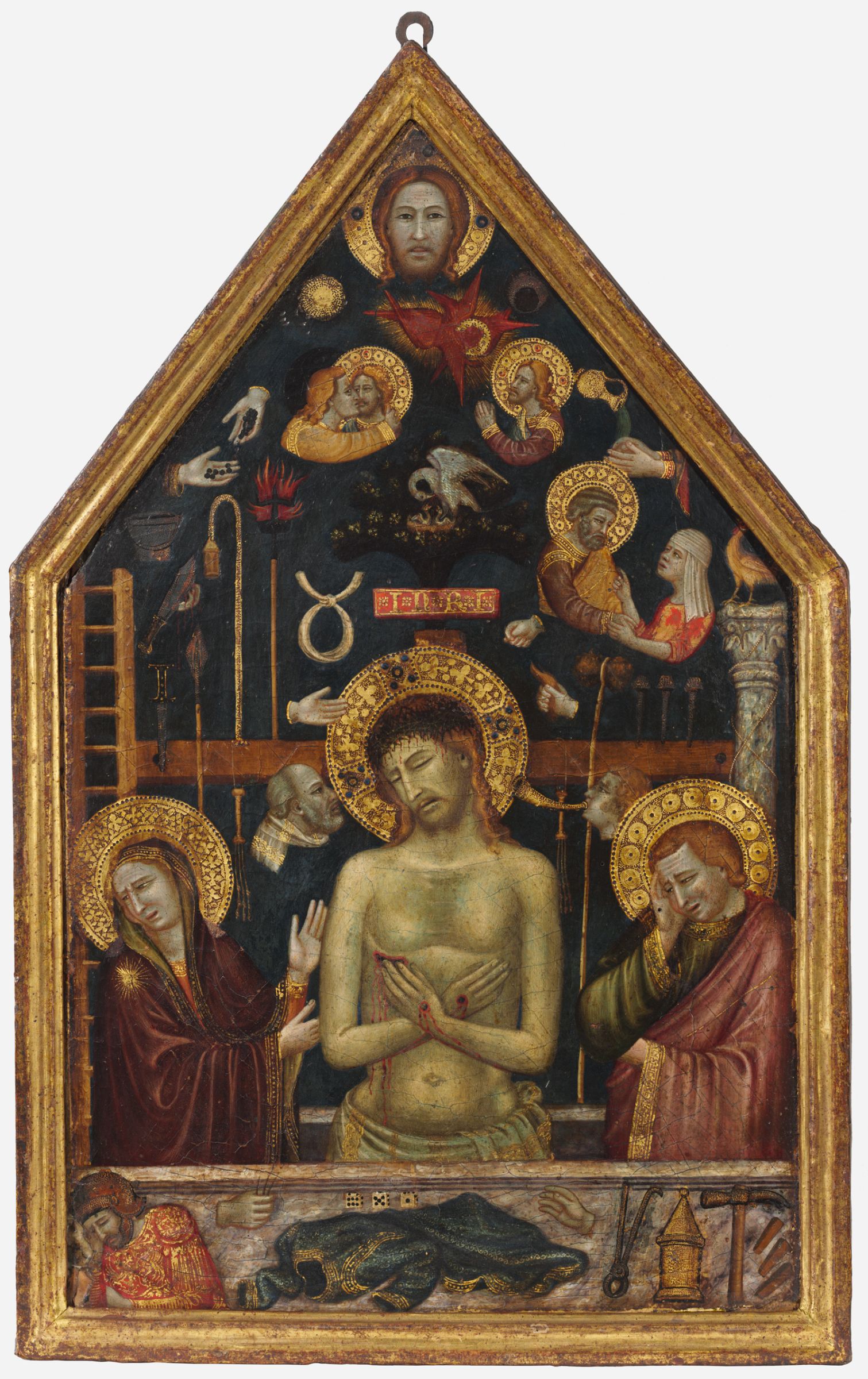
This is a fourteenth-century panel painting by Roberto Oderisi of Naples depicting the Man of Sorrows and the Arma Christi.
Creator
Roberto Oderisi
Source
Harvard Art Museums
http://www.harvardartmuseums.org/art/230884
http://www.harvardartmuseums.org/art/230884
Date
c. 1354
Contributor
Jason Rosenberg
Rights
Harvard Art Museums
MOL Object Item Type Metadata
What is it?
This is a medieval panel painting depicting Christ as the Man of Sorrows with the Arma Christi interspersed around him. The Man of Sorrows image is an intriguing and unique depiction of the Passion, in part because it does not represent a specific scene from the Bible (Belting 1980/1981, 4). Rather, Christ is found in a “state of living death” (Eisler 1969, 233). For example, in this painting Christ is in his tomb (accompanied by a grieving Mary and St. John) with his hands crossed in a funereal manner, but he is standing instead of lying down; the Cross is located behind him and his wounds are fresh, but he is no longer nailed to the Cross (Belting 1980/1981, 6; Harvard Art Museums, Object Files; Schiller 1971, 213). As the eye moves upwards from the tomb’s inhabitants, several scenes from the Passion are depicted in brief (e.g. the Agony in the Garden) until one reaches the transfigured image of Christ at the apex of the painting (Schiller 1971, 213; Harvard Art Museums, Object Files).
Throughout the painting, the Arma Christi are depicted, which are the instruments used against Christ up until the Crucifixion (“Arma Christi” 2013). The Arma Christi, often coupled with the Man of Sorrows in medieval artwork, are almost all present in this panel painting (“Arma Christi” 2013). This suggests a comprehensive account of the Passion that sets the scene for the image of the Man of Sorrows, which by itself lacks a reference to a specific Biblical event.
Regarding the object as a whole, it measures 68.6 x 42.9 x 4.6 cm including the frame (Harvard Art Museums, “The Man of Sorrows”). This seems somewhat small for the amount of detail and the number of icons contained within the painting, and more so given the object’s function as is described in another section. The wood is likely poplar, which has warped over time (Harvard Art Museums, Object Files; Meagher 2010; “Panel Painting” 2013). The ground almost certainly consists of a “very thick” layer of gesso, on which gold leaf and egg tempera paint are applied (Harvard Art Museums, Object Files). There is a significant amount of gilding in the image itself, such as on the halos and the sun as well as on the front face of the frame. Finally, the originality of the frame is unknown, although at the very least, given its somewhat battered appearance, it is not modern. No signs of the past presence of hinges can be found on the frame, but on the other hand the panel painting’s shape seems fitting for a diptych or triptych. In fact, this panel is believed, based on an eighteenth-century text, to be the middle panel of a polyptych (Wilkins 1974, 129).
Throughout the painting, the Arma Christi are depicted, which are the instruments used against Christ up until the Crucifixion (“Arma Christi” 2013). The Arma Christi, often coupled with the Man of Sorrows in medieval artwork, are almost all present in this panel painting (“Arma Christi” 2013). This suggests a comprehensive account of the Passion that sets the scene for the image of the Man of Sorrows, which by itself lacks a reference to a specific Biblical event.
Regarding the object as a whole, it measures 68.6 x 42.9 x 4.6 cm including the frame (Harvard Art Museums, “The Man of Sorrows”). This seems somewhat small for the amount of detail and the number of icons contained within the painting, and more so given the object’s function as is described in another section. The wood is likely poplar, which has warped over time (Harvard Art Museums, Object Files; Meagher 2010; “Panel Painting” 2013). The ground almost certainly consists of a “very thick” layer of gesso, on which gold leaf and egg tempera paint are applied (Harvard Art Museums, Object Files). There is a significant amount of gilding in the image itself, such as on the halos and the sun as well as on the front face of the frame. Finally, the originality of the frame is unknown, although at the very least, given its somewhat battered appearance, it is not modern. No signs of the past presence of hinges can be found on the frame, but on the other hand the panel painting’s shape seems fitting for a diptych or triptych. In fact, this panel is believed, based on an eighteenth-century text, to be the middle panel of a polyptych (Wilkins 1974, 129).
Why was it made?
As is discussed further in other sections, this panel painting was originally located in the Santa Maria Incoronata church in Naples, Italy (Harvard Art Museums, Object Files). This church was built in 1352, just two years prior to the likely date of the panel painting’s creation following the coronation of Louis and Giovanna I (anglicized as Joanna I), the Queen of Naples (Crowe and Cavalcaselle 1903, 95-96). Thus, it is probable that the panel painting was commissioned alongside the construction of the church as part of the interior decoration. The image of the Man of Sorrows was likely chosen for its emotional and spiritual effect on the viewer. Italian artists depicting the Passion wanted the audience to feel Christ’s suffering, especially in the time of the Black Death when it became important to give the populace’s strife a religious basis (Sorabella 2008; Clifton 1997, 20-22). The Man of Sorrows was a powerful way of evoking such emotions, and indeed it was used not only in painting but also in illuminated manuscripts such as Books of Hours (Boynton 2013, 117). In this panel painting, we see the wounded body of Christ wearing the Crown of Thorns, standing in his own tomb. If this were not enough to move the viewer to grief, we see a heartbroken Mary gesturing for us to behold the injustices done to Christ. The presence of the Arma Christi, too, are designed for the same purpose. Gertrud Schiller notes, “The devotions of the Arma Christi were connected with pardon or a promise of protection that assured Christ’s mercy to him who suffered with him” (Schiller 1971, 191). The question arises, however, if churchgoers could actually see the Arma Christi and other details of the panel painting. I note in another section that for a church altarpiece, the panel is relatively small in size. Certainly, priests and other holy figures near the altar would be able to view the painting in detail, which is fitting as they would be the ones most capable of understanding the significance of the Arma Christi images. For the common worshippers in the church, though, it does not seem that the intricate details of Oderisi’s work would be visible to them. The features of the panel become blurred when one stands far away from it, but one thing stands out: the body of Christ. It is the lightest colored part of the painting, and it pops out at the viewer amidst the dark blue background. While we cannot know whether or not Oderisi intended this effect, it is intriguing to think that when all other aspects of the painting disappeared in the eyes of its churchgoing audience, Christ remained.
Who made it?
Bernard Berenson identifies the artist of this painting as Roberto Oderisi of Naples (Berenson 1923, 72). He based this identification on the similarity of this panel painting to the frescoes of the Incoronata and to the Eboli Crucifixion panel painting at the Church of San Francesco, the latter of which is signed by Oderisi (Berenson 1923, 72-75). Very little is known of Oderisi, but his stylistic influences have been widely recognized. Namely, in Oderisi’s artwork the influence of Pietro Cavallini, Simone Martini, and Giotto are apparent (Harvard Art Museums, Object Files; Berenson 1923, 72-75). Giotto in particular held an enormous sway over late medieval Italian painters, leading to more depth and natural human features in their work (Meagher 2010). Lastly, one may wish to search this panel painting for an image of Oderisi, but it is exceedingly doubtful that any of the figures in the work are self-portraits of the artist. In the sixteenth century, Giorgio Vasari identified many late medieval self-portraits, including ones produced by Giotto (Ames-Lewis 2000, 211-212). However, scholarship now suggests that Vasari’s identifications in early works are dubious at best (Ames-Lewis 2000, 212). In fact, Professor Francis Ames-Lewis of the University of London states, “No autonomous self-portrait is…known before the early fifteenth century” (Ames-Lewis 2000, 212-213). Nevertheless, certain Renaissance artists such as Albrecht Dürer claimed that artists have an innate tendency to paint figures that look like themselves (Ames-Lewis 2000, 210-211). Perhaps, then, when we stare at Peter, John, or even the sleeping guard in the bottom-left corner of Oderisi’s painting, we are staring at vague likenesses of Oderisi himself.
Where was it produced?
Since the artist, the Neapolitan Roberto Oderisi, is known, it is almost certain that this panel painting was produced in or around Naples, Italy. This southern Italian origin is corroborated by a number of facts. First, medieval European panel paintings were constructed out of many different woods, but in Italy poplar was dominant (Meagher 2010; “Panel Painting” 2013). Indeed, conservationists have noted that Oderisi’s panel is most likely made of poplar (Harvard Art Museums, Object Files). In addition, the depiction of the Man of Sorrows had been present in the Byzantine Empire for several centuries (Belting 1980/1981, 5-6; Eisler 1969, 235). Since southern Italy was part of the Byzantine Empire until 1071, and trade between the two regions continued to flourish after the split, it is unsurprising to find the Byzantine Man of Sorrows in Naples (Meagher 2010). Finally, the extensive use of gold leaf in this panel painting is found in many other late medieval Italian works (Passeri 2015, 102-103).
Where did it go?
This panel painting was originally located in the Santa Maria Incoronata church in Naples in the mid-fourteenth century (Harvard Art Museums, Object Files). Its function there is discussed in another section. It seems that it remained in this location for several centuries, since there is a text from the 1700s that mentions this panel painting as being located in the Incoronata (Wilkins 1974, 129). This long-term stay in the church is supported by the good condition of the painting, as if it did move about for a long period of time it is difficult to imagine that the quality of the panel would have been preserved. If we do assume that the panel painting was still in the Incoronata in the eighteenth century, then a possible period of turmoil in which the panel could have been removed is the Napoleonic Wars in the beginning of the nineteenth century. It should be stressed, nevertheless, that the time when the panel left the church truly is unknown. In the summer of 1922, Bernard Berenson spotted the panel painting in Florence and proceeded to urge his acquaintance Grenville Winthrop to purchase it (Harvard Art Museums, Object Files). Winthrop, a well-known art collector, then possessed the painting for more than a decade before the Fogg Art Museum acquired it in 1937 (Harvard Art Museums, “The Man of Sorrows”).
When was it made?
The panel painting is believed to have been created around 1354 (Harvard Art Museums, “The Man of Sorrows”; Harvard Art Museums, Object Files). This is due to the stylistic traits it closely shares with the frescoes in the Santa Maria Incoronata church in Naples, which have been dated to that decade (Harvard Art Museums, Object Files; Berenson 1923, 72-75). This dating to the late Middle Ages is supported by a variety of evidence. Panel paintings were popular in the thirteenth and fourteenth centuries in Italy, particularly as altarpieces (Meagher 2010; “Panel Painting” 2013). In addition, in this period in Italy, gold leaf was derived from gold coins, and the “return to gold in Italy’s monetary system in the twelfth and thirteenth centuries is reflected in works of art by an extensive and increasing use of gold leaf” (Passeri 2015, 102-103). Fittingly, this panel painting incorporates gold leaf in a number of locations, from the halos to the gilt frame (if taken to be original). Moreover, as Bernard Berenson notes, surrounding Christ’s head are “hands making signs of contempt, a youth blowing a horn, [and] a citizen spitting” (Berenson 1923, 70). The Mocking of Christ was only present in Italian art since the eleventh century, which puts a lower bound on the panel’s date of origin (Hourihane 2013, 31).
How was it used?
This panel painting was created for use in the church of Santa Maria Incoronata in Naples, where it seems to have remained for several centuries as described in another section (Harvard Art Museums, Object Files). In fact, it is believed to have been the main panel in a polyptych that formed the church’s altarpiece (Harvard Art Museums, Object Files; Wilkins 1974, 129). This prominent location is particularly interesting given the painting’s small size, as it seems unlikely that many of its details could be perceived from the pews. Nevertheless, such a location is supported by the presence of blisters in the paint, which may have been cause by candle flames (Harvard Art Museums, Object Files). These small blisters can be seen, for instance, in the vicinity of Christ’s right hand. The subject matter of the painting is fitting for a late medieval church, as the Man of Sorrows and Arma Christi were devotional subjects in which viewers could share in Christ’s suffering in accordance with the Bible’s command (Schiller 1971, 191-198).
How was it made?
The panel is likely constructed from dried planks of poplar, as is common for medieval Italian panel paintings (Harvard Art Museums, Object Files; Meagher 2010). While poplar is vulnerable to warping, it has the benefit of coming in large widths so fewer planks need to be joined together (“Panel Painting” 2013). The planks would be glued together using size, a derivative of animal skin, and oftentimes the frame would then be attached (Meagher 2010; “Panel Painting” 2013). Next, gesso would have been applied as a ground, in a particularly thick layer for this panel (Meagher 2010; Harvard Art Museums, Object Files). Clay called bole would be used to smooth the panel’s surface, followed by the application of gold leaf (Meagher 2010). This gold would be derived from Italian gold coins, and after burnishing it would be decorated using various metal rods known as punches (Meagher 2010; Passeri 2015, 102-103; Thompson 1956, 223-224). Lastly, egg tempera paint would be applied, which has the unique benefit of retaining its color as it ages (Thompson 1956, 63).
Material Composition
Tempera and gold on panel
Functional Category
Devotional object
Rights
Harvard Art Museums
Identifier
1937.49
Sources and Further Reading
Ames-Lewis, Francis. The Intellectual Life of the Early Renaissance Artist. New Haven: Yale University Press, 2000.
“Arma Christi.” In Grove Encyclopedia of Medieval Art and Architecture. Oxford University Press, 2013. www.oxfordreference.com.ezp-prod1.hul.harvard.edu/view/10.1093/acref/
9780195395365.001.0001/acref-9780195395365-e-141?rskey=7EbBrI&result=141.
Belting, Hans. “An Image and Its Function in the Liturgy: The Man of Sorrows in Byzantium.” Dumbarton Oaks Papers 34/35 (1980/1981): 1-16.
Berenson, Bernard. “A Panel by Roberto Oderisi.” Art in America 11 (1923): 69-76.
Boynton, Susan. “From Book to Song: Texts Accompanying the Man of Sorrows in the Fourteenth and Fifteenth Centuries.” In New Perspectives on the Man of Sorrows, edited by Catherine Puglisi and William Barcham, 117-146. Kalamazoo: Medieval Institute Publications, 2013.
Clifton, James. The Body of Christ in the Art of Europe and New Spain, 1150-1800. Munich: Prestel, 1997.
Crowe, Joseph, and Giovanni Cavalcaselle. Giotto and the Giottesques. Vol. 2, A History of Painting in Italy. London: John Murray, 1903.
Eisler, Colin. “The Golden Christ of Cortona and the Man of Sorrows in Italy: Part Two.” The Art Bulletin 51 (1969): 233-246.
Harvard Art Museums. “The Man of Sorrows.” Object files. Accessed October 19, 2016.
Hourihane, Colum. “Defining Terms: Ecce Homo, Christ of Pity, Christ Mocked, and the Man of Sorrows.” In New Perspectives on the Man of Sorrows, edited by Catherine Puglisi and William Barcham, 19-47. Kalamazoo: Medieval Institute Publications, 2013.
Meagher, Jennifer. “Italian Painting of the Later Middle Ages.” The Metropolitan Museum of Art. Last modified September 2010. www.metmuseum.org/toah/hd/iptg/hd_iptg.htm.
“Panel Painting.” In Grove Encyclopedia of Medieval Art and Architecture. Oxford University Press, 2013. www.oxfordreference.com.ezp-prod1.hul.harvard.edu/view/10.1093/acref/
9780195395365.001.0001/acref-9780195395365-e-1745?rskey=I3Sddn&result=1.
“The Man of Sorrows.” Harvard Art Museums. Accessed October 24, 2016. http://www.harvardartmuseums.org/art/230884.
Passeri, Irma. “Gold coins and gold leaf in early Italian paintings.” In The matter of art: Materials, practices, cultural logistics, c. 1250-1750, edited by Christy Anderson, Anne Dunlop, and Pamela H. Smith, 97-115. Manchester: Manchester University Press, 2015.
Schiller, Gertrud. The Passion of Jesus Christ. Vol. 2, Iconography of Christian Art. Translated by Janet Seligman. London: Lund Humphries, 1971.
Sorabella, Jean. “The Crucifixion and Passion of Christ in Italian Painting.” The Metropolitan Museum of Art. Last modified June 2008. www.metmuseum.org/toah/hd/pass/hd_pass.htm.
Thompson, Daniel. The Materials and Techniques of Medieval Painting. New York: Dover, 1956.
Wilkins, David. “Review of I pittori alla corte Angioina di Napoli, 1266-1414, e un riesame dell' arte nell'età fridericiana by Ferdinando Bologna.” The Art Bulletin 56 (1974): 127-130.
“Arma Christi.” In Grove Encyclopedia of Medieval Art and Architecture. Oxford University Press, 2013. www.oxfordreference.com.ezp-prod1.hul.harvard.edu/view/10.1093/acref/
9780195395365.001.0001/acref-9780195395365-e-141?rskey=7EbBrI&result=141.
Belting, Hans. “An Image and Its Function in the Liturgy: The Man of Sorrows in Byzantium.” Dumbarton Oaks Papers 34/35 (1980/1981): 1-16.
Berenson, Bernard. “A Panel by Roberto Oderisi.” Art in America 11 (1923): 69-76.
Boynton, Susan. “From Book to Song: Texts Accompanying the Man of Sorrows in the Fourteenth and Fifteenth Centuries.” In New Perspectives on the Man of Sorrows, edited by Catherine Puglisi and William Barcham, 117-146. Kalamazoo: Medieval Institute Publications, 2013.
Clifton, James. The Body of Christ in the Art of Europe and New Spain, 1150-1800. Munich: Prestel, 1997.
Crowe, Joseph, and Giovanni Cavalcaselle. Giotto and the Giottesques. Vol. 2, A History of Painting in Italy. London: John Murray, 1903.
Eisler, Colin. “The Golden Christ of Cortona and the Man of Sorrows in Italy: Part Two.” The Art Bulletin 51 (1969): 233-246.
Harvard Art Museums. “The Man of Sorrows.” Object files. Accessed October 19, 2016.
Hourihane, Colum. “Defining Terms: Ecce Homo, Christ of Pity, Christ Mocked, and the Man of Sorrows.” In New Perspectives on the Man of Sorrows, edited by Catherine Puglisi and William Barcham, 19-47. Kalamazoo: Medieval Institute Publications, 2013.
Meagher, Jennifer. “Italian Painting of the Later Middle Ages.” The Metropolitan Museum of Art. Last modified September 2010. www.metmuseum.org/toah/hd/iptg/hd_iptg.htm.
“Panel Painting.” In Grove Encyclopedia of Medieval Art and Architecture. Oxford University Press, 2013. www.oxfordreference.com.ezp-prod1.hul.harvard.edu/view/10.1093/acref/
9780195395365.001.0001/acref-9780195395365-e-1745?rskey=I3Sddn&result=1.
“The Man of Sorrows.” Harvard Art Museums. Accessed October 24, 2016. http://www.harvardartmuseums.org/art/230884.
Passeri, Irma. “Gold coins and gold leaf in early Italian paintings.” In The matter of art: Materials, practices, cultural logistics, c. 1250-1750, edited by Christy Anderson, Anne Dunlop, and Pamela H. Smith, 97-115. Manchester: Manchester University Press, 2015.
Schiller, Gertrud. The Passion of Jesus Christ. Vol. 2, Iconography of Christian Art. Translated by Janet Seligman. London: Lund Humphries, 1971.
Sorabella, Jean. “The Crucifixion and Passion of Christ in Italian Painting.” The Metropolitan Museum of Art. Last modified June 2008. www.metmuseum.org/toah/hd/pass/hd_pass.htm.
Thompson, Daniel. The Materials and Techniques of Medieval Painting. New York: Dover, 1956.
Wilkins, David. “Review of I pittori alla corte Angioina di Napoli, 1266-1414, e un riesame dell' arte nell'età fridericiana by Ferdinando Bologna.” The Art Bulletin 56 (1974): 127-130.
Files
Citation
Roberto Oderisi, “The Man of Sorrows,” CB 51 Omeka, accessed September 21, 2026, https://cb51-16.omeka.fas.harvard.edu/items/show/243.