Seal of Constantine imperial strator and kommerkiarios of the West (X c.)
Dublin Core
Title
Seal of Constantine imperial strator and kommerkiarios of the West (X c.)
Seal of Constantine imperial strator and kommerkiarios of the West (X c.)
Subject
Byzantine Lead Seal
Description
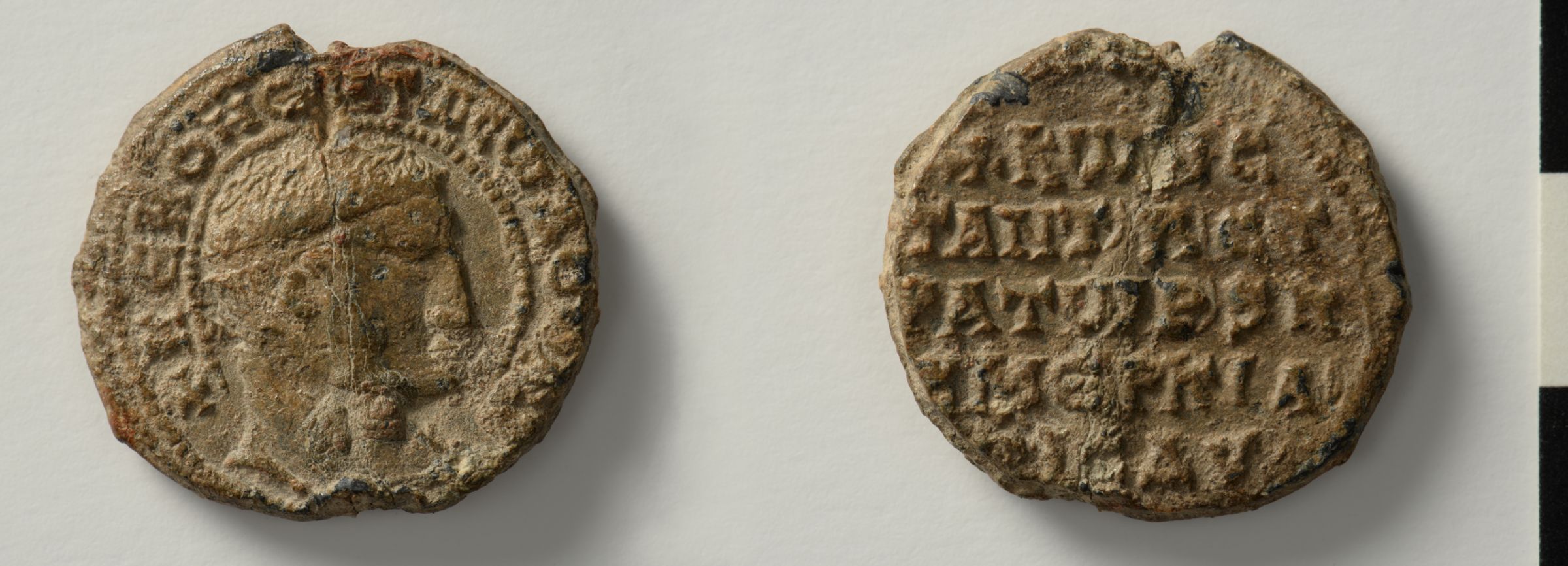
A 10th century lead seal of the Byzantine Period. The obverse of the has a depiction of an athlete wearing a crown. The reverse has an inscription written in Greek.
Creator
The Kommerikarioi of the Bulkan Peninsula
Source
Harvard Art Museum
http://www.harvardartmuseums.org/collections/object/73138?position=2
http://www.harvardartmuseums.org/collections/object/73138?position=2
Publisher
President and Fellows of Harvard Art College
Date
Sometime around the reign of Constantine VII (r. 945-959)
Contributor
Daniel Bailey
MOL Object Item Type Metadata
What is it?
This is a tenth century Byzantine lead seal of an individual named Constantine, an imperial strator and kommerkiarioi of the West during his time. A depiction of an athlete with a broad neck and straight nose wearing a crown is presented on the obverse of the seal, and an inscription written in Greek (which can be read as: Lord help your servant Constantine, Imperial strator and kommerkiarios of the West) on the reverse of the seal.("Constantine Imperial Strator and Kommerkiarios of the West (tenth Century).” )This seal can be dated some time around the 10th century and was created in Eastern Europe during the Byzantine Period, more specifically during the reign of Constantine VII who ruled from 945 A.D. and 959 A.D. (President and Fellows of Harvard College. "Seal of Constantine Imperial Strator and Kommerkiarios of the West (X C.).")
Why was it made?
This seal served a dual purpose: to verify and secure the contents which it held. Like other Byzantine seals, it was used to verify that the documents they were sent with were authorized and came from the individual from which it stated it was from. It was a way to prove that the contents that the seal contained had not been unsealed or tampered with. Essentially, lead seals were used to lock official and private correspondence as well as to authenticate documents. The use of seals became a form of document security and way for individuals to present their status and repute in the Byzantine society. (Oikonomides, 1985, 3-8) These included individuals such as the ones who played roles in the Church as well as higher status individuals, such as those in the bureaucracy of the Byzantine Empire. This lead seal was used by a government official in the West of the Byzantine Empire, particularly around the Balkan Peninsula. He would have used this seal in order to make known to the individual receiving the correspondence of documents he sent that it indeed came from him, and if the seal remained intact, the contents of such letter would not have been compromised. (“Online Catalogue of Byzantine Seals”). The choice of the inscription on the seal would have been something personal to the individual who made the seal as well. In this case, the choice of an athlete reflects the more secular aspects present in the Byzantine Empire at the time that this individual might have enjoyed: thus one could speculate that the individual Constantine was one who could have enjoyed athletics and/or sports of his time. Whether or not he participated in athletics is unclear. “Lord help your servant Constantine” is the phrase inscribed on the seal: this personal prayer on the seal is reflective of the Christian elements heavy in the Byzantine Empire at this time, as well as allows one to see the personal aspect of the choice of words inscribed on the seal: this phrase on the seal would have been something chosen by Constantine himself and the reason why is something only he could have known. Finally, the individual states his status and repute in society as high standing government official: a recipient of the documents the seal held would know exactly who it was coming from, and thus be able to identify based on the seal whether or not it was indeed authentic and if the seal were not broken, know as well the contents had not been compromised.(Cheynet, Jean-Claude, and Claudia Sode, 2003)
Who made it?
Although the exact person cannot be stated in the making of this seal, one could definitely speculate that a craftsman specializing in seals, appointed by Constantine, would have created the personal boulloterion for Constantine's use. As this is an iron-forged tool used in the sealing of blanks, one could definitely speculate that a blacksmith was in charge of creating the signature look that would be engraved in the tool for Constantine's use. Constantine would have had a seal made for him based on his repute and standing in society. Based on the inscription of the seal, one can deduce based on his rank, office, and level of authority in society as to why he would have a seal made. According to the seal, in addition to the honorific title of strator, Constantine was a Kommerkiarioi. The Kommerikarioi was a monetary government position responsible for the collecting of the ten percent tax on merchandise in the Byzantine empire, particularly in the ninth and tenth century. A kommerkiarioi (a financial official in the Byzantine Empire) was positioned with a city or region, and in this case Constantine was the kommerkiarioi of the West, which allows one to deduce that he was the tax collector of a part of the Balkan Peninsula (they’re would have definitely been other Kommerkiaroi in the West, each with their own city and region), as well as their own personal seal as well. As a government official in charge of the collection of taxes, it would have been important that information regarding the finances of the empire, particularly the Balkan peninsula, would have to have some form of security and officiating in order to avoid falsified documents claiming to come from Constantine. Constantine would have had his personal boulloterion made in order to make seals like this one, seal that he could attach to his official government documents so individuals who would receive these documents would know that they were in fact from who they said they were from. ("Constantine Imperial Strator and Kommerkiarios of the West (tenth Century).” )
Where was it produced?
No precise location can be given as to the exact origin of the seal's making. However, as this is a Byzantine seal, it is safe to assume that it was made somewhere in Eastern Europe. As it belonged to the Western Byzantine section, the object could have been made in the Bulkan Peninsula by a craftsman or ironsmith who specialized in the making of boulloterion ("Constantine Imperial Strator and Kommerkiarios of the West (tenth Century)").
Where did it go?
The seal belonged to the Imperial Stator and the Kommerkiaroi of the West, it is safe to assume that this seal traveled much around the Balkan Peninsula, particularly around the Byzantine West. However, it can be stated that Byzantine seals traveled all around the Byzantine Empire, so a seal such as this one would have made its way much around the entirety of the Byzantine state, especially since it belonged to an individual with a fiscal government role. ("Seal of Constantine Imperial Strator and Kommerkiarios of the West (X C.).") ("Constantine Imperial Strator and Kommerkiarios of the West (tenth Century)").
When was it made?
Although the precise date is not known, this seal was made circa 10th century sometime around the reign of Constantine VII, who ruled solely from 945 to 959 A.D. ("Seal of Constantine Imperial Strator and Kommerkiarios of the West (X C.)."
How was it used?
This seal would have been used on a document, letter, or piece of paper sent by the Kommerkiaroi of the West at the time. This seal would have been his official "signature" on his document, in order to let it be known that it came from him. It would have been used to secure his documents, as well as make sure that those he corresponded with knew what they were receiving was official, as it contained the seal of the Imperial strator and Kommerkiarioi of the West. (Oikonomides, 1985, 3-10) ("Constantine Imperial Strator and Kommerkiarios of the West (tenth Century)").
How was it made?
Byzantine seals were more than often made from lead, (but could be made from gold, bronze, or silver) and would begin as two blank rounded discs of whatever material used to make them in slate moulds. Each blank would have a hollow channel running through the center, which would allow for the string to be threaded to the document. pressed against the strings that were attached to the document, letter, or paper they were meant to secure.The particular design of the specific seal woudl be careved on a pair of dies. A Boulloterion, a form of pliers would then be used to held these two dies. Now that these pliers held the images or writing ingrained in them,they would then be pressed on the two lead circles together in order to give the seal its custom and unique depiction. The striking of the seal would also help the channel or center of the blanks collapse around the string. (Oikonomides 1985, 3-5) ("Introduction") (“Online Catalogue of Byzantine Seals”)
Material Composition
This seal was made from Lead (Pb). It has a diameter of 25 millimeters and and a net weight of 10.79 grams.
("Seal of Constantine Imperial Strator and Kommerkiarios of the West (X C.)") ("Constantine Imperial Strator and Kommerkiarios of the West (tenth Century)").
("Seal of Constantine Imperial Strator and Kommerkiarios of the West (X C.)") ("Constantine Imperial Strator and Kommerkiarios of the West (tenth Century)").
Identifier
1951.31.5.1748
Sources and Further Reading
"Byzantine Seals." The Barber Institute of Fine Arts. University of Birmingham, 31 Jan. 2014. Web. 23 Oct. 2016.
Cheynet, Jean-Claude, and Claudia Sode. Studies in Byzantine Sigillography. Leipzig: K.G. Saur, 2003. Print.
"Constantine Imperial Strator and Kommerkiarios of the West (tenth Century)." Dumbarton Oaks Research Library and Collection. Dumbarton Oaks, n.d. Web. 09 Oct. 2016.
"Constantine VII Porphyrogennetos (945–959)." Dumbarton Oaks Research Library and Collection. Dumbarton Oaks, n.d. Web. 23 Oct. 2016.
"Introduction: Byzantine Seals and Sigliography." Dumbarton Oaks Research Library and Collection. Dumbarton Oaks, n.d. Web. 23 Oct. 2016.
Lopez, Robert Sebastian. "Constantine VII Porphyrogenitus." Encyclopedia Britannica Online. Encyclopedia Britannica, n.d. Web. 10 Oct. 2016.
Nesbitt, John. Catalogue of Byzantine Seals at Dumbarton Oaks and in the Fogg Museum of Art. Washington, DC: Dumbarton Oaks Research Libr. and Coll, 2009. Print.
"Online Catalogue of Byzantine Seals." Dumbarton Oaks Research Library and Collection. Dumbarton Oaks, n.d. Web. 23 Oct. 2016.
Oikonomidès, Nicolas. Byzantine Lead Seals. Washington, D.C.: Dumbarton Oaks, 1985. Print.
Oikonomidès, Nicolas. A Collection of Dated Byzantine Lead Seals. Washington, D.C.: Dumbarton Oaks Research Library and Collection, 1986. Print.
Cheynet, Jean-Claude, and Claudia Sode. Studies in Byzantine Sigillography. Leipzig: K.G. Saur, 2003. Print.
"Constantine Imperial Strator and Kommerkiarios of the West (tenth Century)." Dumbarton Oaks Research Library and Collection. Dumbarton Oaks, n.d. Web. 09 Oct. 2016.
"Constantine VII Porphyrogennetos (945–959)." Dumbarton Oaks Research Library and Collection. Dumbarton Oaks, n.d. Web. 23 Oct. 2016.
"Introduction: Byzantine Seals and Sigliography." Dumbarton Oaks Research Library and Collection. Dumbarton Oaks, n.d. Web. 23 Oct. 2016.
Lopez, Robert Sebastian. "Constantine VII Porphyrogenitus." Encyclopedia Britannica Online. Encyclopedia Britannica, n.d. Web. 10 Oct. 2016.
Nesbitt, John. Catalogue of Byzantine Seals at Dumbarton Oaks and in the Fogg Museum of Art. Washington, DC: Dumbarton Oaks Research Libr. and Coll, 2009. Print.
"Online Catalogue of Byzantine Seals." Dumbarton Oaks Research Library and Collection. Dumbarton Oaks, n.d. Web. 23 Oct. 2016.
Oikonomidès, Nicolas. Byzantine Lead Seals. Washington, D.C.: Dumbarton Oaks, 1985. Print.
Oikonomidès, Nicolas. A Collection of Dated Byzantine Lead Seals. Washington, D.C.: Dumbarton Oaks Research Library and Collection, 1986. Print.
Files
Citation
The Kommerikarioi of the Bulkan Peninsula, “Seal of Constantine imperial strator and kommerkiarios of the West (X c.),” CB 51 Omeka, accessed September 22, 2026, https://cb51-16.omeka.fas.harvard.edu/items/show/244.