Lamp/Censer with Scenes from the Life of Christ
Dublin Core
Title
Lamp/Censer with Scenes from the Life of Christ
Lamp/Censer with Scenes from the Life of Christ
Subject
Lamp/Censer
Description
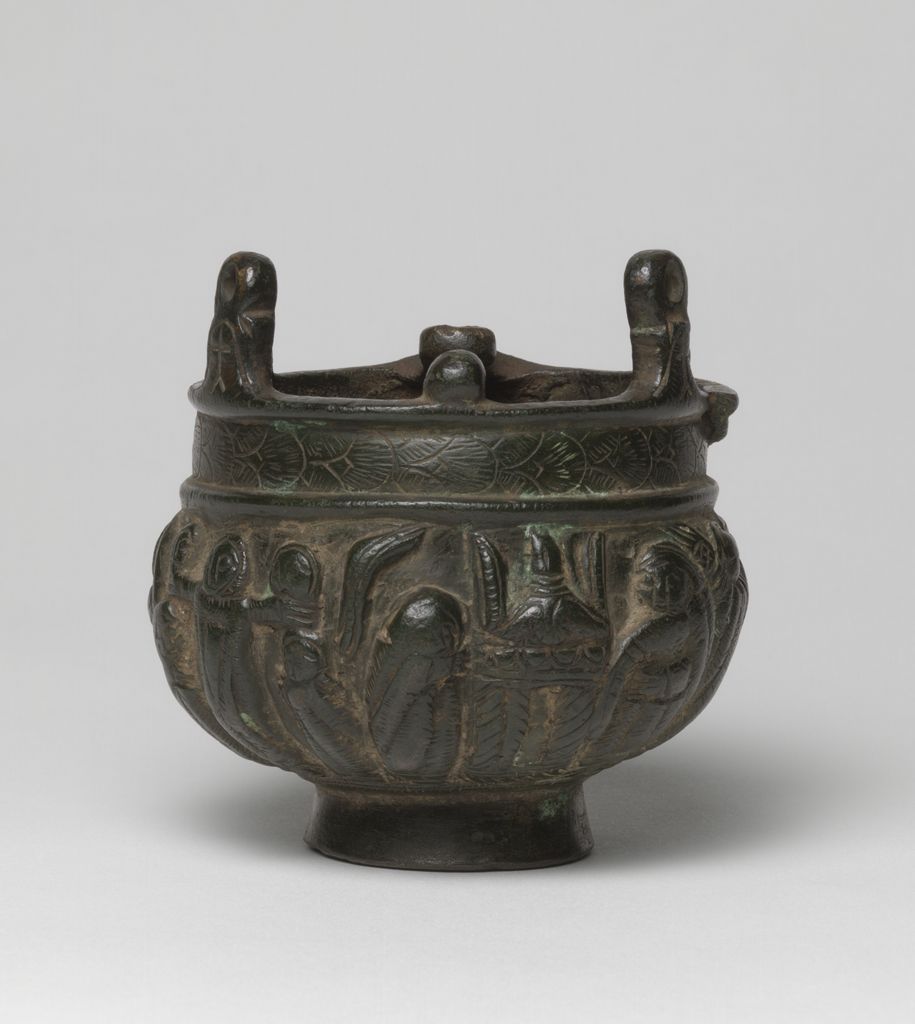
This is a bronze/copper alloy lamp/censer with five scenes from the life of Christ: the Annunciation, the Nativity, the Baptism, the Crucifixion, and the Women at the Tomb.
Creator
Tim Cammarata
Date
6th-9th century
Contributor
Tim Cammarata
Rights
Harvard Art Museum
Type
Lamp/Censer
MOL Object Item Type Metadata
What is it?
This is a lamp/censer which boasts five scenes from the life of Christ: the Annunciation, the Nativity, the Baptism, the Crucifixion, and the Women at the Tomb. The angel Gabriel and Mary are visible in the first scene, signifying the Annunciation, at which Gabriel proclaimed that Mary would conceive Jesus. In the Nativity scene, the baby Jesus is seen in a manger, with two animals close behind him (possibly an ox and ass) and Mary and Joseph on opposite sides. Next, in the Baptism scene, John the Baptist is seen baptizing Jesus, accompanied by a dove (representing the Holy Spirit) and an angel. The Crucifixion scene depicts Jesus on the cross, along with two figures on opposite sides of him. Two faces appear above each of Christ’s hands as well, but neither is distinguishable. Finally, the tomb scene depicts two women on opposite sides of a symbolic tomb of Christ. The tomb depicted appears more like a tent for a king, which might be seen in processions. As Jesus was more than likely buried in a cave (at least according to scripture), the tomb depicted here must have been symbolic of Jesus’s role as the savior of the people.
The scenes described above are quite common in many works of art in the Middle Ages and beyond. Aside from their presence on numerous other censers, these scenes are seen in many paintings. The Crucifixion, especially, is recreated in statue/model form, especially in Catholic churches. While the scenes may not be recreated exactly, common pairs, such as Madonna and Child, appear consistently in art from the Middle Ages. Scenes such as these were relatable for many believers, as they reflected scripture and offered visual representations of Christ and his life.
This censer appears to have been made of a copper alloy (bronze). Its scenes come in the form of crudely carved characters and objects, all rendered in high relief. Three suspension rings are present on the rim of the lamp, a sign that chains would have likely been connected to the lamp. Additionally, there is a six-petal rosette carved into the lamp’s underside, although its purpose is not clear. There are also various etched designs near the top of the lamp whose purpose/meaning, too, is unknown (Kalavrezou 2003, 202).
The scenes described above are quite common in many works of art in the Middle Ages and beyond. Aside from their presence on numerous other censers, these scenes are seen in many paintings. The Crucifixion, especially, is recreated in statue/model form, especially in Catholic churches. While the scenes may not be recreated exactly, common pairs, such as Madonna and Child, appear consistently in art from the Middle Ages. Scenes such as these were relatable for many believers, as they reflected scripture and offered visual representations of Christ and his life.
This censer appears to have been made of a copper alloy (bronze). Its scenes come in the form of crudely carved characters and objects, all rendered in high relief. Three suspension rings are present on the rim of the lamp, a sign that chains would have likely been connected to the lamp. Additionally, there is a six-petal rosette carved into the lamp’s underside, although its purpose is not clear. There are also various etched designs near the top of the lamp whose purpose/meaning, too, is unknown (Kalavrezou 2003, 202).
Why was it made?
This lamp was made for religious/spiritual purposes. It was quite common to light oil lamps/burn incense before religious images, as such was considered a propitiatory offering. It was believed that scented smoke accompanied a person’s prayers to heaven and promoted the intercession of that person’s desired saint (Kalavrezou 2003, 202).
Additionally, Byzantines assigned great power to religious images (as the images on this censer are not technically icons). The Council of Nicaea suggested that “the honor which is paid to the image passes on to that which the image represents.” It was believed that religious depictions (such as the scenes from the life of Christ present on this lamp) could answer prayers, heal the sick, and provide protection. For these reason, the lamp was also made to reside in and protect the home (“Icons”).
Additionally, Byzantines assigned great power to religious images (as the images on this censer are not technically icons). The Council of Nicaea suggested that “the honor which is paid to the image passes on to that which the image represents.” It was believed that religious depictions (such as the scenes from the life of Christ present on this lamp) could answer prayers, heal the sick, and provide protection. For these reason, the lamp was also made to reside in and protect the home (“Icons”).
Who made it?
While the specific creator of the lamp remains unknown, the lamp was presumably made by a specialized craftsman or smith. These craftsmen operated throughout the Byzantine world in cities and villages. Bronze and iron were the most common crafting materials and thus it is very plausible that this lamp was made in a typical crafting shop (“Byzantine Luxury Arts). Additionally, a large number of similar lamps have been discovered across Egypt, Syria, and Turkey, which suggests that they were quite commonplace and possibly made in a number of crafting shops across the Byzantine world. This claim is also supported by the fact that all lamps of this type were not alike. Each had anywhere from four to nine scenes from the life of Christ, and the actual scenes were not consistent across lamps (Gonosova and Kondoleon 1994, 274-77). It seems logical to think that individual workshops would produce lamps of a certain kind, that is, lamps with a common set of scenes. With this assumption, different workshops might have had different templates, so to say; each would have replicated lamps with specific scenes. The scenes themselves and the number of scenes could have been due to any number of factors. Perhaps different areas assigned greater importance to certain scenes of Christ. It seems unlikely that individual workshops would have produced a variety of lamps when mass-producing one style makes more sense, given that the lost-wax process could have been used with each replica to create another replica and so on.
Where was it produced?
Given that similar lamps were discovered in Egypt, Syria, and Turkey, this lamp is postulated to have originated in the Holy Land, a central location for all three. Most obviously, however, depictions of Jesus and other religious/biblical figures point to the Holy Land as a place of production, as this censer was most likely made as a veneration object, meant to be used for religious purposes. Additionally, this censer shares motifs and compositional units with Syro-Palestinian art, also suggesting that it might have come from the Holy Land. From this, it is deduced that perhaps lamps such as this one were taken home as a token of a person’s pilgrimage. This could explain the variation among and prevalence of lamps. The images do appear to be both places of pilgrimage and places of scriptural significance. In addition to their biblical significance (as is explained above), these places continued to be visited long after the death of Jesus. Pilgrims would have viewed them as spots for veneration—as a way to, in a sense, relive Jesus’s life. Because the scenes are displayed chronologically, however, an argument can be made that they are meant to map places of spiritual significance rather than pilgrimage. It would make sense to depict pilgrimage spots in the order they would be visited, but because many of the spots are in the same general area, this argument may not hold (Gonosova and Kondoleon 1994, 274-77).
Where did it go?
Similar lamps have been found in Egypt, Syria, and Turkey, but it is difficult to deduce the path of travel of this lamp. If the Holy Land hypothesis is true, this lamp was carried out from the Arabian Peninsula to another region of the Byzantine empire and plausibly used by a single family for worship (Gonosova and Kondoleon 1994, 274-77). Gonosova’s analysis also suggests that this censer might have originated in Egypt. A nearly identical censer at the Virginia Museum of Fine Arts bears resemblance to several other censers with accepted Egyptian provenance, suggesting that production may not have been limited to a central location such as the Holy Land. It can also be hypothesized that censers which may have come from the Holy Land were reproduced in the areas to which they were brought by pilgrims and others. That is, original copies from the Holy Land were replicated and further disseminated to other areas surrounding the Holy Land.
When was it made?
While it is generally believed that this lamp was made between the 6th and 9th century, there is no clear evidence to support this claim. According to the Harvard Art Museum, it belongs to a class of censers from the 6th and 7th century, a time during which many pilgrims made their way to the Holy Land to pay homage to Christ. While this claim is unsubstantiated, it is plausible, given that the scenes on the lamp correspond to various location the pilgrims might have gone to relive/honor the experiences of Christ (e.g. going to the Jordan River).
According to the Virginia Museum of Fine Arts, this censer bears resemblance to oil ampullae from the Holy Land because of its selection of subjects. These oil ampullae for a “distinct and homogenous” group that can be dated to the 6th/7th century. However, while oil ampullae had well-executed inscriptions to corroborate their dating, censers were rarely inscribed and were much less homogenous, suggesting that they were made over a long period of time and thus are difficult to date (Gonosova and Kondoleon 1994, 274-77).
According to the Virginia Museum of Fine Arts, this censer bears resemblance to oil ampullae from the Holy Land because of its selection of subjects. These oil ampullae for a “distinct and homogenous” group that can be dated to the 6th/7th century. However, while oil ampullae had well-executed inscriptions to corroborate their dating, censers were rarely inscribed and were much less homogenous, suggesting that they were made over a long period of time and thus are difficult to date (Gonosova and Kondoleon 1994, 274-77).
How was it used?
This lamp/censer was presumably suspended from a bar or hook and filled with oil or incense, which was then burned. As described above, the three suspension rings suggest that three connected chains were attached to the censer, connecting it to the aforementioned bar or hook. Additionally, images of a very similar lamp from the Virginia Museum of Fine Arts show chains attached, confirming, at least, that chains accompanied this censer. However, it can also be argued that the censer was held by its chains, as is common in various churches during incense rituals. It seems more likely that the censer was hung though, due to the fact that families would incorporate it in their worship. That is, they would need their hands free during prayer. The woman of the house was charged with keeping the flame of the lamp burning constantly, suggesting that the presence of a lit lamp brought about/maintained a religious presence in the house (Kalavrezou 2003, 202).
How was it made?
This lamp was made by way of the lost wax process. An original lamp was first modeled in wax. Then, this model was covered in damp clay, with the exception of a small hole. The clay was then left to dry. When the clay was sufficiently dry, the model was inverted and heated to allow the wax to drain out of the small hole. This cast was then cut in half. Following this, a core mold was made to allow molten metal to shape itself. Finally, molten metal was poured into the cast and around the core to create a metal model/cast of the original lamp.
Material Composition
According to the Harvard Art Museum, this lamp is made of a mixed copper alloy. The alloying elements include copper, tin, lead, and zinc. Other elements include iron, nickel, silver, antimony, and arsenic.
Rights
Harvard Art Museum
Identifier
1975.41.140
Sources and Further Reading
Bibliography
"Byzantine Luxury Arts." ABC-CLIO. http://ancienthistory.abc-clio.com/Search/Display/1510775?terms=metalworking&sType=multi.
Caseau, Beatrice. "Incense and Fragrances: from House to Church." Unpublished typescript, April 6, 2007. Accessed October 10, 2016. http://www.academia.edu/494438/From_house_to_church_the_introduction_of_incense.
Didron, Adolphe Napoleon. Christian Iconography. Translated by E. J. Millington. London: Henry G. Bohn, 1851.
Gonosova, Anna, and Christine Kondoleon. "Censer." In Art of Late Rome and Byzantium, 274-77. Richmond: Virginia Museum of Fine Arts, 1994.
Kalavrezou, Ioli. "Lamp/Incense Burner with Scenes from the Life of Christ." In Byzantine Women and Their World, 202. Cambridge: Harvard University Art Museum, 2003.
Maguire, Henry. "Style and Ideology in Byzantine Imperial Art." Gesta 28, no. 2 (1989): 217-31.
National Gallery of Art. "Icons." National Gallery of Art. Accessed October 8, 2016. http://www.nga.gov/content/ngaweb/features/byzantine/icons.html.
Noble, Joseph Veach. "The Wax of the Lost Wax Process." American Journal of Archaeology 79, no. 4 (October 1975): 368-69.
President and Fellows of Harvard College. "Lamp or Censer with Scenes from the Life of Christ." Harvard Art Museums. Accessed October 24, 2016. http://www.harvardartmuseums.org/art/215371.
Rautman, Marcus. "Byzantine Art." ABC-CLIO. http://ancienthistory.abc-clio.com/Search/Display/1510778?terms=byzantine+art&sType=multi.
von Grunebaum, G. E. "Byzantine Iconoclasm and the Influence of the Islamic Environment." History of Religions 2, no. 1 (Summer 1962): 1-10.
"Byzantine Luxury Arts." ABC-CLIO. http://ancienthistory.abc-clio.com/Search/Display/1510775?terms=metalworking&sType=multi.
Caseau, Beatrice. "Incense and Fragrances: from House to Church." Unpublished typescript, April 6, 2007. Accessed October 10, 2016. http://www.academia.edu/494438/From_house_to_church_the_introduction_of_incense.
Didron, Adolphe Napoleon. Christian Iconography. Translated by E. J. Millington. London: Henry G. Bohn, 1851.
Gonosova, Anna, and Christine Kondoleon. "Censer." In Art of Late Rome and Byzantium, 274-77. Richmond: Virginia Museum of Fine Arts, 1994.
Kalavrezou, Ioli. "Lamp/Incense Burner with Scenes from the Life of Christ." In Byzantine Women and Their World, 202. Cambridge: Harvard University Art Museum, 2003.
Maguire, Henry. "Style and Ideology in Byzantine Imperial Art." Gesta 28, no. 2 (1989): 217-31.
National Gallery of Art. "Icons." National Gallery of Art. Accessed October 8, 2016. http://www.nga.gov/content/ngaweb/features/byzantine/icons.html.
Noble, Joseph Veach. "The Wax of the Lost Wax Process." American Journal of Archaeology 79, no. 4 (October 1975): 368-69.
President and Fellows of Harvard College. "Lamp or Censer with Scenes from the Life of Christ." Harvard Art Museums. Accessed October 24, 2016. http://www.harvardartmuseums.org/art/215371.
Rautman, Marcus. "Byzantine Art." ABC-CLIO. http://ancienthistory.abc-clio.com/Search/Display/1510778?terms=byzantine+art&sType=multi.
von Grunebaum, G. E. "Byzantine Iconoclasm and the Influence of the Islamic Environment." History of Religions 2, no. 1 (Summer 1962): 1-10.
Files
Citation
Tim Cammarata, “Lamp/Censer with Scenes from the Life of Christ,” CB 51 Omeka, accessed September 22, 2026, https://cb51-16.omeka.fas.harvard.edu/items/show/242.