Coin of Romanos IV
Dublin Core
Title
Coin of Romanos IV
Coin of Romanos IV
Subject
Byzantine Coin
Description
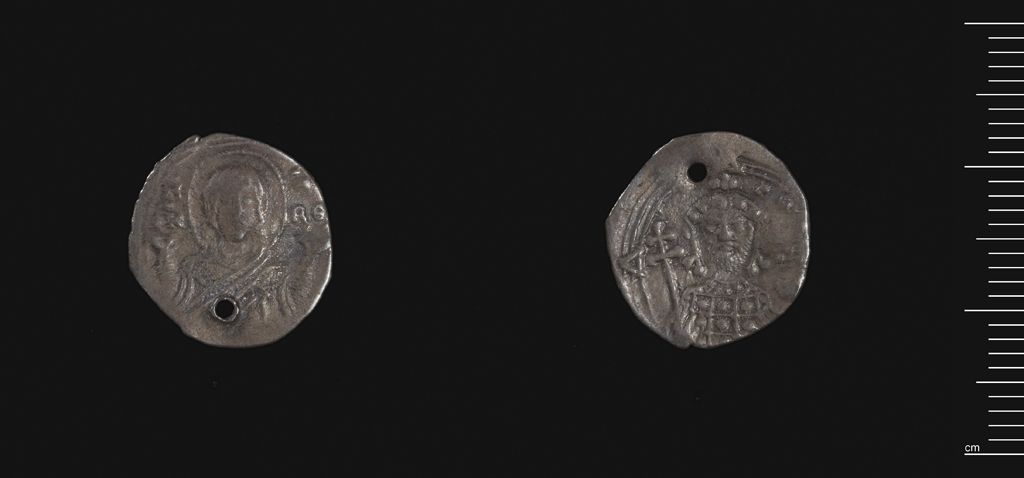
A struck silver coin from the Byzantine period made around 1068-1071. Depicts the emperor Romanos IV on one side and the Virgin on the other.
Source
Harvard Art Museums http://www.harvardartmuseums.org/collections/object/74588?position=7
Date
1068-1071 CE
Contributor
Sky Russell
Rights
Harvard Art Museums
Format
Silver coin
0.72 g
0.72 g
Language
Greek
Type
Coin
MOL Object Item Type Metadata
What is it?
This is a silver coin created between 1068 and 1071 CE in the Byzantine Empire under the rule of Romanos IV Diogenes. It it thought to have been produced in Constantinople (Thrace). It is a small coin, with an average diameter of only about 1.5 cm. The coin features a depiction of the Virgin Mary on the obverse and Romanos IV Diogenes on the reverse. It also has a hole in it, suggesting that it may have had uses beyond currency. (HAM Webpage.)
Romanos IV Diogenes secured the throne by marrying the widowed Empress Eudokia. A Cappadocian noble, he began his rule with a good reputation. However, when a battle he led ended in the Byzantine rout at Manazkert, he was taken prisoner by the enemy. The opposing party in Constantinople would not stand for this and resorted to blinding and killing him soon after his release. (Ostrogorsky, 1969.)
The Virgin Mary was a very popular holy figure in the 11th century. Romanos III (1028-1034) felt a particular devotion to her and founded a monastery in Constantinople in her honor. In the following years the Virgin Mary was a major subject of devotion in the Byzantine world (Grierson 1999,35.) The inscriptions surrounding her on the coin feature the Greek letters mu rho and theta, which represent an abbreviation for “Mother of God.” (cutsinger.net)
Romanos IV Diogenes secured the throne by marrying the widowed Empress Eudokia. A Cappadocian noble, he began his rule with a good reputation. However, when a battle he led ended in the Byzantine rout at Manazkert, he was taken prisoner by the enemy. The opposing party in Constantinople would not stand for this and resorted to blinding and killing him soon after his release. (Ostrogorsky, 1969.)
The Virgin Mary was a very popular holy figure in the 11th century. Romanos III (1028-1034) felt a particular devotion to her and founded a monastery in Constantinople in her honor. In the following years the Virgin Mary was a major subject of devotion in the Byzantine world (Grierson 1999,35.) The inscriptions surrounding her on the coin feature the Greek letters mu rho and theta, which represent an abbreviation for “Mother of God.” (cutsinger.net)
Why was it made?
There are three prominent reasons for the coin’s creation: currency, devotion, and glorification of the emperor. The first is most obvious, being that the object is after all a coin. Being made of silver, it would have had practical value as currency. The second can be inferred from the hole in the coin and the presence of the Virgin Mary on the obverse side. The third is apparent from the depiction of Romanos IV. In the Byzantine period it was commonplace for the imperial class to utilize the coin as a means of exalting the emperor (Bellinger, 70.) The coin was made as an object to honor the holy as well as to glorify the royal.
It is also interesting to consider the purpose of this coin in the context of Byzantine amulet tradition. Healing or protection amulets were commonly used by people of the Byzantine period. They were believed to have magic properties, sometimes even medicinal. These amulets would often feature Jesus or various saints on their faces (metmuseum.org). We see that this coin of Romanos IV instead utilizes imagery of the Virgin Mary, but it is still very reasonable for us to look at this coin like an amulet. It is possible that real amulets were quite expensive and unattainable to lower classes, seeing as they were sometimes decorated but precious "healing" stones (metmuseum.org). So we can extrapolate that the coin that doubled as an amulet would have been a popular option for those who could not afford to buy a purely protective charm.
It is also interesting to consider the purpose of this coin in the context of Byzantine amulet tradition. Healing or protection amulets were commonly used by people of the Byzantine period. They were believed to have magic properties, sometimes even medicinal. These amulets would often feature Jesus or various saints on their faces (metmuseum.org). We see that this coin of Romanos IV instead utilizes imagery of the Virgin Mary, but it is still very reasonable for us to look at this coin like an amulet. It is possible that real amulets were quite expensive and unattainable to lower classes, seeing as they were sometimes decorated but precious "healing" stones (metmuseum.org). So we can extrapolate that the coin that doubled as an amulet would have been a popular option for those who could not afford to buy a purely protective charm.
Who made it?
The coin would have been made in a workshop of artisans specializing in struck coins. These people would have to be masters at handling metal and metalworking tools. Workshops could function like factories, possibly producing up to 100 coins per person per hour. (Lawrence.edu)
Where was it produced?
It is most probable that this coin was produced in Constantinople, the center of coin production and minting in late 11th century Byzantium. This information is inferred from the location of excavation of this coin in relation to others. For this particular object, it is unclear where the coin was originally found. However, similar silver coins dated to the same century have been found to be concentrated in Thrace. Though it is possible that the coin was produced elsewhere (other minting centers included Macedonia and Kherson) it is most likely that Constantinople was its birthplace. (Laiou et al. 2002)
Where did it go?
Although this is technically a coin, it is very possible that it did not circulate as a conventional coin would. It may have been worn as a devotional charm or amulet and it consequently would have stayed with an owner for many years. This leads to a few possibilities. One is that the coin did not move very far from Constantinople because it was passed among a local community as a personal devotional object. Another is the possibility of pilgrimages. The tradition of Christian pilgrimage was present in Byzantium and pilgrims often carried portable objects of prayer (Vikan 1982, 3-4). Therefore, the coin may have visited various holy sites around the Byzantine empire, probably those associated with the Virgin Mary.
The Virgin Mary imagery may also tell us something about the owner of the coin. The Virgin was often honored in the Byzantine world as a "role model" for women (Lee 2014). In turn, she may also have been considered a protector of women more so than men. This would lead us to believe that the primary audience of a coin like this was Byzantine women. It is possible that this coin was meant to be worn predominantly by women, and perhaps would have circulated from mother to daughter or among religious sisterhoods.
The Virgin Mary imagery may also tell us something about the owner of the coin. The Virgin was often honored in the Byzantine world as a "role model" for women (Lee 2014). In turn, she may also have been considered a protector of women more so than men. This would lead us to believe that the primary audience of a coin like this was Byzantine women. It is possible that this coin was meant to be worn predominantly by women, and perhaps would have circulated from mother to daughter or among religious sisterhoods.
When was it made?
The coin was made some time between 1068 and 1071 when Romanos IV ruled the Byzantine Empire.
How was it used?
We can imagine that this coin was worn like an amulet by a devoted Byzantine Christian. It would have been a charm, perhaps for personal protection and prayer. Holed coins of this sort appear in other regions throughout the world and in various time periods, and we know that the purpose of the hole is usually to be able to string the coin. The coin may have travelled on pilgrimages with its owner or been a token distributed as proof of pilgrimage. This is possible because the coin’s production site, Constantinople, was also home to various holy sites. (Vikan 1982, 4). It is also worth noting that in the 5th century, gold coins were commonly used for currency but silver coins were reserved for ceremonial purposes (Dictionary of Middle Ages). Though this notion did not necessarily remain in the 11th century, it is plausible that the tradition of silver coins as ceremonial objects remained in the culture to an extent.
How was it made?
This is a struck coin, meaning that the designs were imprinted with a hammer and metal stamps. The process consisted of taking a flan (a sheet of metal) and placing it between two dies (metal stamps with the designs in them) and then hammering the whole thing until both sides of the metal sheet were printed on (Lawrence.edu). The appearance of the coin suggests that each coin was not made very carefully or with particular attention to neatness. For example, the image of Romanos is off-center while the border around him suggests that he was meant to be centered. We can extrapolate from this that these coins were produced quickly and in large quantities so that they could be distributed to large populations of people.
Material Composition
Silver
Functional Category
Both currency and devotional object as well as object of imperial glorification. The honoring of the emperor was probably the main function that the imperial class intended for the coin to have. However once produced, the coin must have served mainly as a devotional object. The coin may have actually been used for trade as well but it is possible that it was a sort of “emergency cash” that was an object of worship that could double as currency when necessary.
Rights
Harvard Art Museums
http://www.harvardartmuseums.org/collections/object/74588?position=7
http://www.harvardartmuseums.org/collections/object/74588?position=7
Identifier
1951.31.4.1615
Sources and Further Reading
Harvard Art Museums. “Coin of Romanos IV.” http://www.harvardartmuseums.org/collections/object/74588. Accessed 20 Nov 2016
Ostrogorsky, George. "History of the Byzantine State." Joan Hussey, trans. (1957, 3rd rev, ed. 1969)
Grierson, Philip. "Byzantine Coinage." (1999 Dumbarton Oaks).
Laiou, Angeliki E. et al. "The Economic History of Byzantium:
From the Seventh through the Fifteenth Century." (2002 Dumbarton Oaks.)
Lawrence.edu. "The Production of Ancient Coins" https://www2.lawrence.edu/dept/art/BUERGER/ESSAYS/PRODUCTION7.HTML. Accessed 21 Nov 2016.
Vikan, Gary. "Byzantine Pilgrimage Art." (Dumbarton Oaks 1982.)
Anamnesis: The Webblog of Professor James S. Cutsinger "The Virgin of The Sign." http://www.cutsinger.net/blog/?page_id=13. Accessed 21 Nov 2016
Strayer, Joseph. "Mints and Money, Byzantine." Dictionary of the Middle Ages Vol 8. New York: Charles Scribner's Sons, 1987.
Lee, Ashley. "Magic, mimesis, and the Annunciation to Mary: Six early Byzantine cameos and the Late Antique tradition of medical amulets." (PhD diss., Northern Illinois University, 2014).
The Metropolitan Museum of Art. "Popular Religion: Magical Uses of Imagery in Byzantine Art." http://www.metmuseum.org/toah/hd/popu/hd_popu.htm Accessed 8 Nov 2016.
Ostrogorsky, George. "History of the Byzantine State." Joan Hussey, trans. (1957, 3rd rev, ed. 1969)
Grierson, Philip. "Byzantine Coinage." (1999 Dumbarton Oaks).
Laiou, Angeliki E. et al. "The Economic History of Byzantium:
From the Seventh through the Fifteenth Century." (2002 Dumbarton Oaks.)
Lawrence.edu. "The Production of Ancient Coins" https://www2.lawrence.edu/dept/art/BUERGER/ESSAYS/PRODUCTION7.HTML. Accessed 21 Nov 2016.
Vikan, Gary. "Byzantine Pilgrimage Art." (Dumbarton Oaks 1982.)
Anamnesis: The Webblog of Professor James S. Cutsinger "The Virgin of The Sign." http://www.cutsinger.net/blog/?page_id=13. Accessed 21 Nov 2016
Strayer, Joseph. "Mints and Money, Byzantine." Dictionary of the Middle Ages Vol 8. New York: Charles Scribner's Sons, 1987.
Lee, Ashley. "Magic, mimesis, and the Annunciation to Mary: Six early Byzantine cameos and the Late Antique tradition of medical amulets." (PhD diss., Northern Illinois University, 2014).
The Metropolitan Museum of Art. "Popular Religion: Magical Uses of Imagery in Byzantine Art." http://www.metmuseum.org/toah/hd/popu/hd_popu.htm Accessed 8 Nov 2016.
Files
Citation
“Coin of Romanos IV,” CB 51 Omeka, accessed September 23, 2026, https://cb51-16.omeka.fas.harvard.edu/items/show/241.