Browse Items (10 total)
Sort by:
Anonymous Follis
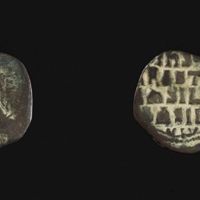
This struck bronze follis has been clipped so much that much of the inscription is gone. The minting location and ruler of the time are uncertain– the information may have originally been in the margins. We can tell that the figure depicted is Christ…
Glass Coin Weight
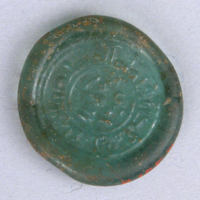
Glass coin weights were used in the Byzantine and Islamic worlds to monitor the weight of coins, assuring quality of the currency. This coin weight is attributed to Egypt and it features an Arabic inscription arranged in concentric circles. The outer…
10th Century Samanid Coin
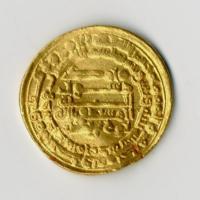
This Islamic coin was minted just as the Samanids conquered al-Muhammadiya (in modern Iran). The central inscription names the propher Muhammad as well as the Samanid rule Nuḥ bin Nasr. The inner circular margin lists the date and location of the…
Histamenon of John I with the Meter Theou
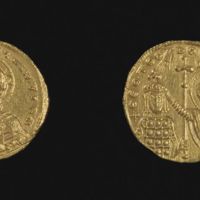
Preserved in excellent condition, this 10th century histamenon was minted in Constantinople under John I. On the obverse is Christ the Pantocrator and on the reverse is John I depicted alongside the Virgin Mary, or "Meter Theou." Both sides feature…
Coin of Constantine IX
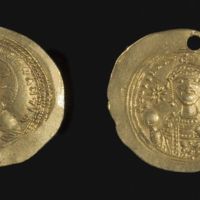
This histamenon is a struck gold coin minted in Constantinople under the Byzantine emperor Constantine IX (r. 1042 - 1055). On the obverse is a depiction of Christ the Pantocrator shown with a cross nimbus and hand raised in blessing. On the reverse…
"Toenail" Hoard
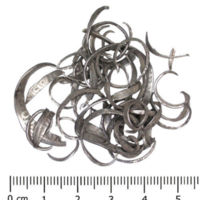
This is a pile of clippings taken from silver coins in 16th-17th century England. The original coins were of Elizabeth I, James I , and Charles I and were thus over 90% fine metal. Clippings of this sort were made to be melted back down, often into…
Folded (Broken) Coin
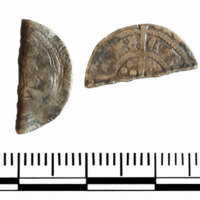
This silver half groat (Medieval English coin) was issued under Henry VI. On the obverse is a crowned bust (probably Henry VI himself) and on the reverse is a cross. The coin was not only clipped but at some point folded, breaking upon unfolding.
Badly Overstruck Coin
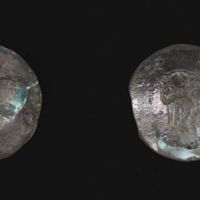
The coin is an example of one that has been "overstruck." This is when an existing coin instead of a blank is used to strike a new coin. Often times this results in layered and unrecognizable designs. In this particular coin the figure of Manuel I…
Gold Ingot
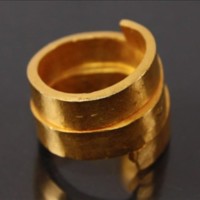
An ingot is a general term for metal mass that has yet to be made into a finished product. These bits of metal would be melted down in order to be formed into jewelry, coins, or other objects. This particular ingot is rolled into a spiral shape,…
14th Century Handheld Die
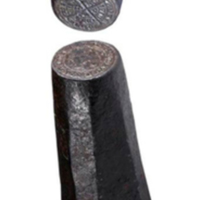
Dies like this one were used to make the designs seen on Medieval coins. A metal blank would be placed between the upper and lower dies, then the upper one would be struck with a hammer. This would leave a design imprinted in the metal disc, creating…